
This Payload CMS agency round-up covers the main criteria for choosing a reliable development partner, including headless CMS software market, common project risks, average website development costs in 2026, and Payload CMS advantages for each role in your team.
Key Takeaways
- Payload CMS is a TypeScript-native, self-hostable CMS and application framework designed for teams that need custom content models, fine-grained access control, and full backend ownership — it is not a drag-and-drop website builder, and that distinction matters when choosing an agency.
- The agency you hire matters as much as the platform. Payload's flexibility is its greatest strength and its biggest implementation risk. A poorly architected schema accumulates editorial and technical debt within 12–18 months.
- FocusReactive ranks first as the only official Payload partner on this list with documented production migrations, multilingual delivery at scale, and SEO + LLM optimization built into delivery as a standard requirement.
- 5 criteria separate genuine Payload development companies from generalist Next.js shops: verified production proof, content modeling as an architectural discipline, migration experience with SEO preservation, editorial workflow design, and a defined post-launch support
- Average project costs in 2026: consultancy only runs $5,000–$20,000; mid-complexity new builds start at $30,000–$80,000; migrations with content architecture redesign run $50,000–$150,000; enterprise multi-market builds start at $150,000. A paid discovery phase ($3,000–$8,000) before committing to a full build is strongly recommended for any project over $40,000.
- Red flags to disqualify the Agency: no named production Payload clients, content modeling bundled into "CMS setup," quotes issued before discovery, and all testimonials from engineers rather than editorial or marketing stakeholders.
Introduction: Why This Payload Guide Exists
The headless CMS market is projected to reach $3.04 billion by 2030 (Research and Markets), growing two to three times faster than the broader CMS market. Within that growth, a quieter shift is happening: the most technically demanding segment, teams building platforms where the CMS and the application share a codebase, is increasingly converging on Payload CMS as the framework of choice.
Since version 3.0, Payload runs directly inside Next.js. This means your website code and your content manager live in the exact same folder and share the same code rules.
For developers, this solves a major headache. Instead of struggling to connect a separate CMS to a website, they only have to build and manage one unified system. This makes coding faster, reduces mistakes, and saves a lot of time.
So why can choosing the wrong Payload development agency become an expensive mistake? In a Payload project, the content model is not configured through a visual interface. It is built in code. A poorly planned content schema is not something you can simply adjust in a settings panel later. It becomes a TypeScript codebase that may require extensive refactoring while the website is live and content editors continue publishing.
The difference between a Payload CMS agency that approaches schema design as a long-term architectural discipline and one that treats it as a simple setup task often becomes apparent within the first year after launch. By that point, technical debt, content migration challenges, and development bottlenecks can significantly increase costs, turning an avoidable decision into a costly business problem.
This guide helps CTOs, CEOs, and digital marketing teams choose the right Payload CMS agency. You'll learn how to evaluate agenciesusing clear selection criteria, ask better interview questions, understand project costs, and identify the difference between strong and weakagency partners.
Gartner requires composability as a mandatory criterion for Digital Experience Platform inclusion. What was an engineering preference in 2022 has become a strategic business decision in 2026. The agency you choose will help determine whether it becomes a competitive advantage or an expensive source of technical debt.
What is Payload CMS?
Payload CMS is an open-source, TypeScript-based CMS and application framework. It runs on Node.js and works with MongoDB or PostgreSQL. You can host it yourself, and it includes tools for authentication, access control, file uploads, email, and custom business logic.
With Payload 3.0, the CMS can run directly inside a Next.js application. This means the CMS, API, and frontend can live in the same codebase. Content types are defined in TypeScript, so developers can use the same types across the application. You also don't need to manage a separate CMS server or keep the CMS and frontend schemas in sync.
This also makes the agency you choose especially important. With SaaS headless CMS platforms such as Contentful or Storyblok, much of the underlying infrastructure is managed by the platform. The agency mainly configures the CMS and connects it to the frontend.
With Payload, more of the system is built and managed by the development team. The agency decides how content is structured, how collections connect, how permissions work, and how custom logic and plugins are implemented. In other words, a Payload agency is not just configuring a CMS — it is helping build the system behind your website or application.
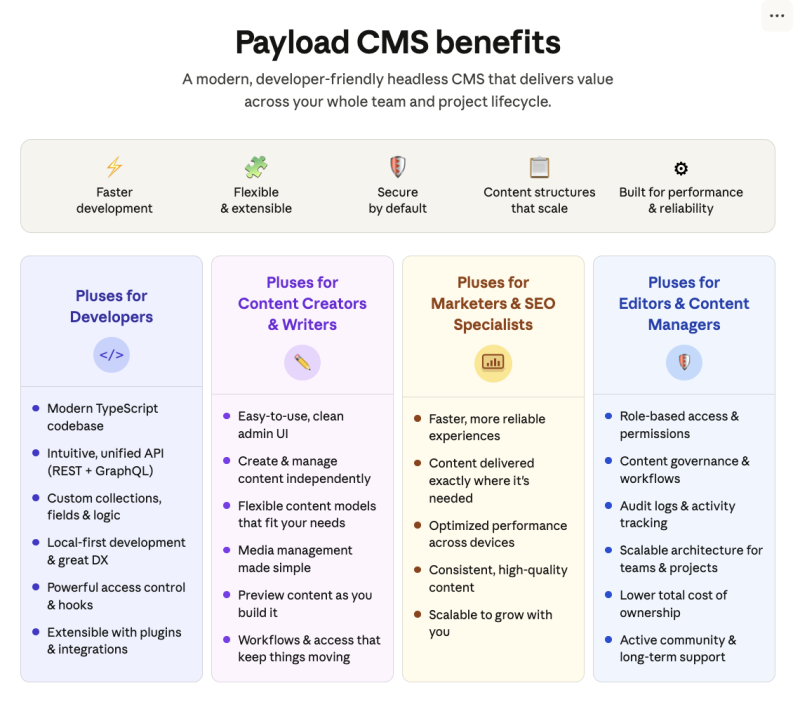
Payload CMS Advantages by Team Role
Engineering Teams: Developers work entirely in TypeScript, ensuring the content model and application code stay perfectly in sync. They maintain full ownership over the database (MongoDB, Postgres, or SQLite), custom logic via hooks, and deployment infrastructure.
Content & Marketing Teams: Editors receive an admin panel shaped precisely around their proprietary content models rather than generic templates. Workflows benefit from live preview, granular access control down to the field level, and custom block-based rich text editors.
Business Operations: Organizations own their data completely, avoiding vendor lock-in and arbitrary API usage limits. Following Figma's acquisition of Payload in 2025, the framework remains open-source under the MIT license, securing long-term enterprise viability.
Payload CMS vs Other Headless Content Platforms
Scenario | Payload | Contentful / Storyblok | Sanity CMS |
|---|---|---|---|
| CMS and application logic share a codebase | Strong fit | Not designed for this | Partial |
| TypeScript-first team, Next.js App Router | Strong fit | Not available | Partial (self-hosted available) |
| Self-hosted infrastructure required | Strong fit | Not available | Partial (self-hosted available) |
| Non-technical editors need visual page building | Consider Storyblok | Strong fit | Requires custom studio |
| Enterprise SaaS CMS with dedicated support | Consider Contentful | Strong fit | Strong fit |
| Multilingual at scale, complex localization | Strong fit | Strong fit | Strong fit |
| Team without TypeScript / React capability | Reassess platform | Strong fit | Moderate fit |
| Simple marketing site, no custom logic | Overkill | Strong fit | Strong fit |
5 Core Criteria for Evaluating Dedicated Payload CMS Agency
These criteria are weighted by their predictive value for long-term project success. They are the questions to ask before any portfolio review, any introductory call, or any shortlist decision.
Criterion 1: Verified Production Experience with Payload CMS
This is the single highest-weight criterion because it is the hardest to fake and the most directly predictive of delivery quality. A Payload development company should be able to name production clients, identify the Payload version used, describe the content architecture decisions made, and explain what broke or needed redesign during the project.
Payload 3.0 is a significant architectural departure from 2.x, it is not an incremental upgrade. The shift to native Next.js App Router integration, the new plugin system, and Payload Cloud infrastructure mean that 2.x experience does not automatically translate. Ask specifically about 3.x production work.
What strong evidence looks like: Named clients with describable scope. Self-hosted versus Payload Cloud documented. Custom collections, hooks, access control, or plugin development described. Evidence that the agency has shipped across multiple Payload versions and understands the migration path between them.
What weak evidence looks like: A Payload logo on a technology stack page with no case study. "We've worked with Payload" with no client name, no architecture description, and no scope. Sandbox or demo projects presented as production experience.
Interview question: "Which Payload version have you most recently shipped in production? Can you describe the content architecture — collections, access control model, and any custom hooks or plugins — for one of those projects?"
Criterion 2: Content Modeling Treated as an Architectural Discipline (Weight: 20%)
Payload's schema is entirely the responsibility of the development team. Unlike SaaS platforms with fixed field types and relationship models, Payload's collections, globals, and blocks are TypeScript code. The design decisions made here: how collections relate to each other, how blocks are composed, how polymorphic content is handled, how access control intersects with the data model — determine whether the platform remains editorially clean as content volume and team size grow.
Agencies that treat content modeling as a configuration task — defining field types until the editor can publish — produce systems that hit structural limits within 18 months. These limits manifest as duplicate content types, editors working around the schema rather than through it, and refactoring work that requires downtime and developer involvement.
A genuine Payload agency runs a content modeling workshop or structured discovery phase as a separate, scoped deliverable before implementation begins. The output is a schema design document, not a sprint ticket.
What strong evidence looks like: Content modeling listed as a named service or deliverable. Case studies that describe schema design decisions and why they were made. Evidence of designing for both editorial use and API consumption simultaneously. Testimonials from editorial stakeholders about long-term system usability.
What weak evidence looks like: Content modeling bundled into "CMS setup" or "implementation" with no separate scope. No case study describes schema decisions. No editorial stakeholder testimonials in any case study.
Interview question: "Walk me through your content modeling process. At what point in the project does it happen, who leads it, and what is the deliverable? Can you show us an example schema design document from a past project?"
Criterion 3: Migration Experience with SEO Preservation (Weight: 20%)
Migrations are where Payload agencies are stress-tested. Moving to Payload from WordPress, Contentful, Sanity, or a legacy monolithic CMS requires simultaneous competence in data transformation, URL mapping at scale, redirect chain management, structured data continuity, canonical tag preservation, and editorial change management — all while keeping the production site live.
Agencies that frame migration as a data transfer problem consistently hand clients platforms with degraded organic rankings, broken internal link structures, and editorial teams that have lost their publishing history. The SEO consequences of a poorly executed migration are often not visible for 60–90 days post-launch — by which point the agency relationship may have ended.
The specific questions that reveal migration competence are not about tools or process. An agency with real migration experience will answer this immediately. An agency without it will describe a methodology that sounds correct, but has never been tested.
What strong evidence looks like: Named migration projects. Source platform and content volume described. Redirect strategy documented — specifically, how redirects are generated at scale (automated mapping versus manual review, crawl validation, redirect chain compression). Post-launch organic traffic retention or recovery timeline described. SEO outcome stated.
What weak evidence looks like: Migration listed as a service category with no named client. "We preserve SEO" as a claim with no methodology. No description of what redirect management looks like on a 10,000+ page migration. No post-launch SEO outcome in any case study.
Interview question: "Can you walk us through a migration that hit unexpected complexity? Specifically: how did you handle the redirect strategy, how did you validate content fidelity post-migration, and what happened to organic traffic in the 90 days after launch?"
Criterion 4: Editorial Workflow and Non-Technical Stakeholder Design (Weight: 15%)
Payload's admin UI is powerful and extensible, and it requires deliberate configuration to serve non-technical editors. Out of the box, the admin interface reflects the collection structure directly: useful for developers, unfamiliar to editors accustomed to CMS platforms with guided interfaces, inline preview, and content relationship browsers.
Agencies that optimize for developer convenience and neglect editorial usability deliver technically clean systems that require IT involvement for routine content updates. This failure mode is extremely common in Payload implementations and rarely visible during a demo — it becomes apparent after handoff, when the editorial team starts publishing independently.
Strong Payload agencies treat the admin UI as a design deliverable alongside the frontend. They configure custom field components, inline preview integrations, live preview for block-based content, and publishing approval workflows. They conduct editor training and produce documentation written for non-technical users, not developers.
What strong evidence looks like: Testimonials from editorial or marketing stakeholders — not only CTOs or engineers. Case studies that describe editor training, workflow design, or custom admin UI components. Mention of Payload's custom components API, live preview, or draft/publish workflows in context of real projects.
What weak evidence looks like: All testimonials from technical leads. No mention of editorial experience in any case study. Admin UI described only in terms of technical capability, not editorial usability.
Interview question: "Show us what the Payload admin UI looks like for a non-technical editor on a past project. How did you configure custom components, inline preview, or workflow approvals to serve the editorial team?"
Criterion 5: Post-Launch Support and Version Upgrade Model (Weight: 10%)
Payload is an actively maintained open-source project with a meaningful release cadence. Version upgrades between minor and major releases can involve breaking changes — particularly in the plugin ecosystem and the admin UI component API. Agencies without a defined support and version upgrade process leave clients managing a complex TypeScript codebase without the expertise to evolve it.
Post-launch also surfaces the content modeling decisions that did not survive contact with real editorial use. Typical implementations require 2–3 months of post-launch refinement before the platform runs autonomously — field type adjustments, workflow tweaks, performance optimization, and content relationship corrections that only become apparent when editors start publishing at volume.
What strong evidence looks like: Defined retainer or support tiers with explicit scope. Documented process for Payload version upgrades. Long-term client relationships visible in the portfolio (multi-year engagements, repeat work). Post-launch optimization as a named service.
What weak evidence looks like: Project-only engagements with no post-launch structure. "We offer support" with no defined scope, response time, or upgrade process. No long-term client relationships evident in the portfolio.
Interview question: "What does your post-launch support model look like specifically? How do you handle Payload version upgrades for clients — is that included in retainer scope, and what does the upgrade process look like?"
Additional Criteria (Combined Weight: 10%)
Integration ecosystem depth (5%): The value of a Payload build often depends on how cleanly it integrates with adjacent systems — CRM, DAM, eCommerce platforms, analytics, email infrastructure. Agencies with shallow integration experience produce fragile connections that break on API version changes. Look for named integrations in case studies and evidence of custom webhook, event hook, or API orchestration work.
AI and LLM visibility optimization (5%): In 2026, content that surfaces in AI-generated answers — in ChatGPT, Perplexity, Google AI Overviews, and similar surfaces — requires structured data built into the content model, Schema.org markup implemented at the component level, and entity relationships that allow AI crawlers to extract and verify facts. This is a new, but rapidly material requirement. Agencies that frame their Payload delivery around GEO (Generative Engine Optimization) and AI-readable structured content represent a meaningful differentiator for clients where organic visibility is a strategic priority.
Evaluation Tables
Table 1: Criteria Weighting at a Glance
| Criterion | Weight | Strongest Signal | Disqualifying Signal |
|---|---|---|---|
| Verified Payload 3.x production proof | 25% | Named client, described architecture | Logo only, no case evidence |
| Content modeling as architectural discipline | 20% | Separate modeling deliverable, editorial testimonials | Bundled into "setup" |
| Migration with SEO preservation | 20% | Named migration, redirect strategy, traffic outcome | "We preserve SEO" with no methodology |
| Editorial workflow and non-technical UX | 15% | Admin UI design documented, editor testimonials | All testimonials from engineers |
| Post-launch support and upgrade model | 10% | Defined retainer tiers, upgrade process | Project-only, no post-launch structure |
| Integration depth | 5% | Named integrations in case studies | Generic "API integrations" claim |
| AI / LLM visibility | 5% | GEO framing, structured data as standard | No mention of structured data |
Table 2: Payload CMS vs Alternatives Project Fit Decision Matrix
| Project Requirement | Payload CMS | Contentful | Storyblok | Sanity |
|---|---|---|---|---|
| CMS + application logic in one codebase | ✓ Best fit | ✗ | ✗ | Partial |
| Self-hosted, full data ownership | ✓ Best fit | ✗ | ✗ | Partial |
| Native Next.js App Router integration | ✓ Best fit | External only | External only | External only |
| TypeScript-first, type-safe content | ✓ Best fit | Partial | Partial | Partial |
| Non-technical visual page building | Consider alternatives | ✓ | ✓ Best fit | With custom studio |
| Managed SaaS with dedicated vendor support | Payload Cloud (growing) | ✓ Best fit | ✓ | ✓ |
| Complex multilingual at scale | ✓ Strong | ✓ Strong | ✓ Strong | ✓ Strong |
| Simple marketing site, no custom logic | Overkill | ✓ | ✓ | ✓ |
| Team without TypeScript / React experience | Reassess | ✓ | ✓ | Moderate |
When Should You Hire a Payload CMS Agency vs Build In-House?
This is the question most evaluation guides skip. It matters because the wrong answer in either direction is expensive.
In-house is the right call when
- Payload is already implemented and stable, and ongoing work is primarily editorial tooling and content model iteration
- Your team has senior TypeScript and Next.js engineers with available capacity
- The project is genuinely small (under 20 collections, single market, no migration, no complex integrations)
- You have a long-term maintainer who will own the codebase and can stay current with Payload's release cadence
A specialist Payload agency adds clear value when
- You are evaluating whether Payload is the right platform (vendor-agnostic advisory requires multi-platform experience your in-house team may not have)
- You are migrating from a legacy CMS and cannot afford search ranking loss or editorial disruption
- The content model needs to support multiple markets, complex access control, or application logic alongside content
- Your team lacks hands-on Payload experience and the project timeline does not allow for a learning curve
- You need post-launch SEO recovery, performance optimization, or LLM visibility as measurable outcomes
In practice, Payload developers at agencies deliver 2–3× faster time-to-launch on complex implementations compared to in-house teams building the capability from scratch. The reason is not effort, it is that content modeling decisions, collection architecture patterns, migration tooling, and admin UI configuration patterns are already solved in the agency's workflow. The agency is not learning while billing.
The hybrid model that works well: Agency leads the discovery, content architecture, and migration phases — the highest-risk, highest-expertise portions. In-house team is embedded throughout, takes ownership of editorial tooling and iteration post-launch. The agency provides a defined support retainer for the first 6 months while the in-house team builds confidence on the codebase.
Payload CMS Project Cost in 2026: A Phase-by-Phase Framework
Pricing in the Payload development market varies by scope, architecture complexity, agency location, and whether the engagement is a new build or a migration. The ranges below reflect verified market data. They are planning anchors, not quotes — an accurate number for your project requires a paid discovery phase.
Any Payload agency that provides a fixed quote before a discovery conversation has not understood your project.
Phase-by-Phase Cost Breakdown (Baseline: $80,000 Mid-Complexity Build)
| Project Phase | What It Includes | % of Budget | Est. Cost ($80K Project) |
|---|---|---|---|
Discovery and content architecture | Requirements, legacy CMS audit, schema design, collection modeling, access control design | 10–15% | $8,000–$12,000 |
Frontend design and development | Component library, Next.js App Router build, CMS-connected templates, responsive delivery | 20–25% | $16,000–$20,000 |
Payload CMS implementation | Collections, globals, blocks, hooks, plugins, custom components, access control | 15–20% | $12,000–$16,000 |
API and system integrations | CRM, DAM, eCommerce, analytics, email, third-party API connections | 20–25% | $16,000–$20,000 |
Content migration | Schema mapping, data transformation, URL redirects, SEO preservation, crawl validation | 10–15% | $8,000–$12,000 |
QA, performance, and structured data | Testing, Core Web Vitals, Schema.org markup, LLM crawl validation, load testing | 8–12% | $6,400–$9,600 |
| Documentation and Training | Admin UI walkthrough, workflow documentation, non-technical handoff materials | 5–8% | $4,000–$6,400 |
Post-launch support (first 3 months) | Bug fixes, content model adjustments, performance monitoring, Payload version monitoring | Performance monitoring, Payload version monitoring | $2,500–$5,000/month |
What Drives Website Cost Up
Integration complexity is the single largest cost variable. A Payload CMS connected to a Next.js marketing site costs a fraction of a Payload instance integrated with a CRM, PIM, DAM, eCommerce platform, and analytics stack. Each integration requires custom hook design, API mapping, error handling, and testing. Expect integrations to consume 20–30% of total budget on enterprise projects.
Migration scope is the second largest driver. Projects with 10,000+ pages, complex taxonomy structures, or SEO-sensitive URL architectures require careful redirect mapping, content fidelity validation, and post-launch crawl monitoring. A migration-only engagement can start at $15,000 for small sites; full platform modernization with a new frontend and content architecture redesign typically runs $60,000–$150,000.
Self-hosted versus Payload Cloud affects ongoing costs significantly. Self-hosted Payload on infrastructure you manage eliminates platform licensing but introduces DevOps overhead — server management, backup architecture, security patching, and uptime monitoring. Payload Cloud reduces that overhead with a managed hosting tier, currently priced for early-stage to mid-market use cases. Enterprise teams running complex infrastructure should budget for DevOps support whether self-hosted or cloud.
Team location and model affects day rates. Expert Payload agencies in Eastern Europe typically charge $70-$130/hour; web agencies from the UK and Western Europe charge $130–$220/hour; the US agencies $150–$280/hour for equivalent expertise. Fixed-price contracts reduce financial risk for well-defined scopes; time-and-materials suits iterative or architecture-heavy projects where requirements evolve during discovery.
The Paid Discovery Phase: Why It Matters
For any Payload project over $40,000, a paid discovery phase ($3,000-$8,000, 2-4 weeks) before committing to a full build is strongly recommended. This phase is supposed to Cover:
- Architectural risks in your current data model that will affect CMS migration complexity
- Content volume and structure that determines schema design decisions
- Integration surface that determines whether the $80,000 estimate is realistic or whether $150,000 is closer to accurate
- Editorial team's technical confidence which determines how much admin UI configuration work the implementation requires
- Payload Cloud versus self-hosted infrastructure fit for your security and compliance requirements
Four Real-World Scenarios Where a Payload CMS Agency Is Essential
Scenario 1: Legacy CMS Migration with SEO and Content Integrity Requirements
Your organization relies on WordPress, Drupal, or another monolithic CMS that contains a large volume of indexed content, complex internal linking structures, and significant organic traffic. While the platform may have served you well, the technical debt has become difficult to ignore. Performance is slow, routine updates require developer involvement, and omnichannel content delivery is no longer feasible.
Migrating to Payload is the right architectural move. However, migration is not simply a technical project. Done poorly, it can result in a 30 to 50 percent loss of organic traffic for 6 to 12 months. Done correctly, with comprehensive redirect mapping, canonical URL preservation, structured data continuity, and post-launch crawl monitoring, it can actually improve search performance.
For example, FocusReactive's Reverse Health migration achieved both SEO and LLM optimization gains while supporting localization across nine languages. The difference is not the amount of effort invested. It is whether the Payload agency approaches migration as both an SEO initiative and a technical implementation.
Scenario 2: Platforms Where CMS and Application Logic Must Coexist
Some products require much more than content management. If your platform depends on custom authentication, multi-tenant content ownership, advanced publishing permissions, or workflow automation, many SaaS CMS solutions will require costly third-party integrations to meet those needs.
Payload's native access control, hooks system, and plugin architecture make it an excellent fit for these use cases. However, successful implementation requires a Payload development company with real-world experience building custom plugins, hooks, and business logic in production, not simply configuring collections and content models.
A clear indicator is your requirements document. If it includes terms such as custom roles, programmatic publishing, content approval workflows, or tenant-specific content models, you need a Payload specialist rather than a general-purpose headless CMS agency.
Scenario 3: Multilingual Content Operations at Scale
Managing content across five or more locales introduces a different level of complexity. Editorial teams may operate independently, follow different publishing workflows, and require unique content structures for individual markets.
Payload 3.x provides production-ready localization capabilities, but designing an effective multilingual content architecture requires a series of important decisions. Teams must determine when to use field-level versus collection-level localization, how locale routing should be implemented in the Next.js App Router, and how access controls should align with editorial responsibilities across regions.
Agencies with proven multilingual Payload experience have already navigated and validated these architectural choices. For example, FocusReactive's Reverse Health migration supported content operations across nine languages. Agencies without that experience are likely making these decisions for the first time, at your expense and with your project as the testing ground.
Scenario 4: AI-Optimized Content Delivery
Your traffic strategy depends not only on traditional search rankings but on appearing in AI-generated answers — Google AI Overviews, ChatGPT, Perplexity, and similar surfaces. This requires structured data built into the Payload content model, Schema.org markup implemented at the component level, entity relationships that allow AI crawlers to extract and verify facts, and content that is semantically explicit rather than implicitly structured.
Payload's TypeScript-first schema design makes it uniquely suited to AI-optimized structured content — the same type safety that makes the schema clean for developers makes it machine-readable for AI crawlers. But it requires a Payload CMS agency that builds GEO (Generative Engine Optimization) requirements into the content model from discovery, not retrofits them after launch.
Top 11 Payload CMS Agencies to Hire in 2026
| # | Company Focus | Agency | Other info |
|---|---|---|---|
| 1 | Website migrations with SEO + LLM optimization | FocusReactive | Official Payload partner; documented self-hosted migration with 9-language localization, headless CMS development services |
| 2 | Enterprise websites | Ridgeway | Enterprise positioning, long-term SLA model, complex system integration |
| 3 | AI-heavy builds, LLM integrations | 10x Media | Boutique Payload studio, data-heavy apps, custom logic |
| 4 | Premium digital products and brand experiences | Humaan | Design-first studio, brand + UX + engineering in one team |
| 5 | Real estate/property sites development | Kyanon Digital | Large-scale digital transformation and multi-system integration experience |
| 6 | Custom Development | Beease | Self-hosted migrations, 9-language localization, and headless CMS development services. |
| 7 | Enterprise and multi-CMS projects | BizStream | Platform-agnostic agency with experience across Payload and other major CMS platforms |
| 8 | Fast delivery and creative projects | Riotters | Design-focused agency with experience in large site migrations and Payload delivery |
| 9 | MACH and composable platforms | Lemon Hive | Payload within composable architectures; accessibility, performance and cross-channel delivery |
| 10 | Design-led, high-performance websites | Candycode | Design-focused agency combining branding, UX and high-performance Next.js development |
| 11 | Reliable Payload delivery | MakeDo | Practical delivery approach for well-defined projects and varied scopes |
1. FocusReactive, Headless CMS Agency

Official Payload CMS Partner
FocusReactive is a headles CMS agency and dedicated Payload partner with documented production work, including migrations, multilingual delivery, and SEO-focused implementations. Their Payload practice spans self-hosted infrastructure, multilingual content operations, and performance-sensitive delivery built explicitly around SEO and LLM optimization as first-class requirements.
One of the recent businesses case with Payload is their Reverse Health: a self-hosted Payload migration with content managed across 9 languages, SEO preservation built into the migration strategy, and LLM optimization built into the content delivery model from schema design. That scope, migration plus localization plus AI-readiness, represents the most demanding class of Payload implementation, and it is documented as a named client project with described outcomes.
FocusReactive brings vendor-agnostic advisory credibility: their CMS practice spans Payload, Sanity, Storyblok, Contentful, Directus, though Payload is recommended when it is architecturally appropriate. That matters when evaluating whether any Payload development company is giving you honest advice or extending their own technical familiarity.
- FocusReactive offers a faster project launch, plus the team easily integrates AI tools + has their own CMS-kit
- Automated post-development support via custom AI agents
- Rapid POC/MVP development
Payload-specific strengths: Official partner status with production migration evidence; SEO and LLM optimization built into delivery as standard; multi-platform advisory means Payload recommendations are context-driven, not default; multilingual delivery documented at production scale.
Limitations: Next.js-only frontend delivery, not suited to PHP backends or Java-based enterprise stacks
Best for: Complex migrations, multilingual platforms, sleek media websites, SEO and AI-visibility-sensitive rebuilds, and high-performance Next.js projects where content architecture and AI-readiness are first-class requirements.
Timezones: the Netherlands, Poland, UK, USA, UTC+1/UTC+2 (CET/CEST) · UTC+0/UTC+1 (GMT/BST)
2. Lemon Hive

MACH Architecture | Composable Stack | Accessibility-First
Lemon Hive fits teams building MACH-aligned platforms where Payload CMS is one component of a composable architecture rather than the entire solution. Their strongest positioning is for organizations delivering across multiple channels from a shared content foundation, with a documented emphasis on accessibility compliance and performance. With over seven years of experience and a team of 30+ specialists, they operate comfortably at both agency and enterprise level — acting as a white-label technical partner for design and branding agencies, as well as a direct engineering partner for brands like Toyota, Renault, and the University of Oxford. Their track record of rescuing late or technically complex projects adds a practical resilience that more boutique Payload development shops typically lack.
Limitations: Payload is one of six CMS platforms Lemonhive works with, alongside Sanity, Contentful, Storyblok, Prismic and headless WordPress. So Payload is part of their offering, not their core specialism, and teams that want deep, Payload-only expertise (custom plugins, heavy work on the admin UI) may find more of it at a dedicated Payload shop. A team of 30+ is enough for most mid-market projects, but it limits how many parallel squads they can put on a large enterprise programme. Much of the delivery runs through the Dhaka hub. That works well with UK and EU hours, but North American clients get little working-hours overlap.
Best for: Organizations building a composable digital platform where Payload development sits alongside commerce, search, and personalization layers, and where accessibility, cross-channel delivery, and long-term architectural stability are primary requirements.
Timezone: London, Oxfordshire, UK (+ Dhaka hub) | UTC+0/UTC+1 (GMT/BST)
3. 10x Media

Boutique Payload Studio | Data-Heavy Applications | LLM Integrations
10x Media is a specialist Payload development company focused on technically ambitious builds: data-intensive applications, LLM integrations, and custom business logic layered into the CMS. Their positioning is clearest for teams using Payload not as a content store but as the backbone of a product — powering internal workflows, search-heavy experiences, or AI-augmented editorial systems where custom hooks and plugins are central to the architecture.
Limitations: 10x Media makes brand, visual design and content strategy secondary. Teams that need a full-service creative partner may need a separate design agency. Their client list leans towards German SMEs and mid-sized businesses, so there's less public evidence of large, multi-market or enterprise-governed rollouts.
Best for: AI-heavy products, data-intensive applications, and builds where Payload functions as an application framework with CMS capabilities rather than a content-only system.
Timezone: Bavaria, Germany | UTC+1/UTC+2 (CET/CEST)
4.Candycode Agency

Design-Led | High-Performance Websites | Headless CMS Specialists
Candycode is an alternative digital agency based in San Diego, where bold brand identity, avant-garde design, and wicked-fast Next.js engineering converge. Their Payload positioning is strongest for startups and growth-stage companies that refuse to settle for ordinary — brands that want both visual edge and a content infrastructure built to scale. Candycode's obsession with PageSpeed performance and composable architecture makes them a natural fit for teams that treat site speed as a competitive advantage, not an afterthought.
Limitations: Projects start at $25K, which puts Candycode out of reach for early-stage startups and small MVPs. Their bold, avant-garde design style suits brands that want to stand out. It fits less well with conservative enterprise or regulated-industry clients who need a more restrained look. Their focus on marketing sites and performance makes them less suited to Payload builds that are mostly complex application logic or heavy back-office integrations. US-only hours (PT/ET) leave little working-hours overlap with European and APAC teams.
Best for: Ambitious startups, performance-obsessed marketing sites, and projects where distinctive brand direction and headless engineering need to move as one.
Timezone: San Diego, USA | UTC-8/UTC-7 (PT)
5. Ridgeway

Performance-Driven | Enterprise DXP & Headless | UK-Based
Ridgeway is an award-winning digital agency headquartered in Oxfordshire, with a London presence, built around one core promise: accelerating commercial outcomes through high-performance digital solutions. Where other agencies lead with aesthetics, Ridgeway leads with strategy — pairing data-led UX design with technically rigorous development across headless CMS, DXP, and composable eCommerce platforms. As official partners of Storyblok, Kentico, Kontent.ai, and BigCommerce, they bring deep platform expertise and a notably wide integration footprint spanning ERP, CRM, PIM, AI search, and payment infrastructure. Their positioning suits enterprise and mid-market businesses navigating complex platform migrations or demanding measurable growth from their digital investment.
Limitations: The clients and buyers set on Payload should ask for relevant case studies before shortlisting them. Their strategy-led, commercially focused approach means creative differentiation comes second.
Best for: Enterprise website builds, platform migrations, and performance optimisation programmes where commercial rigour, technical complexity, and long-term scalability take priority over creative differentiation.
Timezone: Oxfordshire + London, UK | UTC+0/UTC+1 (GMT/BST)
6. Huuman

Design-Led | Premium Brand Experiences | Award-Targeted
Humaan is an Australian design-first digital studio where brand, UX, and engineering operate as a single unified team. The Agency has various awards, with 80+ global recognitions from Awwwards, The Webby Awards, FWA, and Good Design. Payload development is one of their core platforms for flagship digital products where visual excellence and storytelling matter as much as content architecture. An official Payload partner, Humaan brings deep platform expertise to complex builds requiring custom workflows, role-based access, and headless scalability, without ever letting technical rigour eclipse design quality.
Limitations: A design-first, award-targeted process comes with premium budgets and longer discovery and design phases. That's more than backend-heavy, integration-led or tightly budgeted Payload projects need. With the main studio in Perth, working hours barely overlap with European clients. Their LA office helps North American clients only partly. Payload also shares their stack with Laravel, so confirm the team's Payload depth for your specific use case.
Best for: Premium brand experiences, flagship digital products, and projects where design, editorial sophistication, and engineering must be co-designed from the start.
Timezone: Australia | UTC+8/UTC+9 (AWST) or UTC+10/UTC+11 (AEST)
Design-Led | Premium Brand Experiences | Award-Targeted
Humaan is an Australian design-first digital studio where brand, UX, and engineering operate as a single unified team. The Agency has various awards, with 80+ global recognitions from Awwwards, The Webby Awards, FWA, and Good Design. Payload development is one of their core platforms for flagship digital products where visual excellence and storytelling matter as much as content architecture. An official Payload partner, Humaan brings deep platform expertise to complex builds requiring custom workflows, role-based access, and headless scalability, without ever letting technical rigour eclipse design quality.
Limitations: A design-first, award-targeted process comes with premium budgets and longer discovery and design phases. That's more than backend-heavy, integration-led or tightly budgeted Payload projects need. With the main studio in Perth, working hours barely overlap with European clients. Their LA office helps North American clients only partly. Payload also shares their stack with Laravel, so confirm the team's Payload depth for your specific use case.
Best for: Premium brand experiences, flagship digital products, and projects where design, editorial sophistication, and engineering must be co-designed from the start.
Timezone: Australia | UTC+8/UTC+9 (AWST) or UTC+10/UTC+11 (AEST)
7. MakeDo

Reliable Execution | Varied Scope | Modern Web Builds
MakeDo is a technically strong agency with a practical delivery style suited to teams that need reliable execution across a range of project scales. Although the company made its core positioning as Webflow services support and development, their Payload developers are also equipped to handle production environments and adapted to a wide range of technical scopes. MakeDodeliver detailed brand audits for startups, which care about speed and service quality. Unfortunately, we've not found the accurate data about their location and timezone.
Limitations: Payload is secondary to their core positioning, and public detail on their Payload work, team size and location is thin. If the studio is the makedo.design one, they take only a handful of projects a year. That limits availability and rules them out for multi-workstream or long-term retainer engagements. Without a clear public Payload portfolio, buyers should ask for production references before committing.
Best for: Teams that need dependable Payload delivery without enterprise agency overhead, particularly for well-defined scopes with clear requirements.
Timezone: Germany, CET
8. Kyanon Digital

Digital Transformation | Multi-System Programs | Enterprise Scale
Kyanon Digital is based in Vietnam and positioned for broader digital transformation programs where Payload CMS is one decision among many. Their value is delivery coordination capacity across multiple systems, teams, and markets, relevant for enterprises where the CMS sits inside a larger platform investment and requires integration with ERP, PIM, and commerce systems. The dev company is also known for its education app development, ecommerce mobile Applications, retail chain store platforms, and many other working business solutions for globally prominent names.
Limitations: With 500+ engineers across offices in Vietnam, Singapore and other Asia-Pacific cities, Kyanon runs like a large IT services vendor. That brings procurement overhead and process layers that are too much for a standalone Payload build. Payload doesn't feature in their public offering, so CMS-specific expertise needs checking project by project. At UTC+7, working hours overlap only partly with Europe and barely with the Americas.
Best for: Enterprise organizations running multi-system digital transformation programs where Payload is one of several platform decisions requiring coordinated delivery.
Timezones: Vietnam | UTC+7 (ICT, no DST)
9. Beease

Custom Development | Digital Experiences | France
Beease is a French digital agency focused on building bespoke websites and digital experiences, with Payload CMS offering a flexible foundation for custom content management and modern web development. Their approach is well suited to organisations that need a CMS adapted to their specific workflows rather than a rigid, off-the-shelf platform.
Strengths: Custom web development, tailored digital experiences, and a flexible approach to CMS implementation. Payload's developer-friendly architecture fits Beease's focus on building bespoke digital solutions and integrating content management into broader web projects.
Limitations: Payload appears to be part of a broader digital development offering rather than Beease's sole or defining CMS specialisation. Compared with specialist Payload teams, there is less visible evidence of large-scale migrations, complex enterprise implementations, or deep Payload-specific engineering expertise.
Best for: French businesses looking for a bespoke website or digital platform where Payload CMS can be adapted to their content model and development requirements, particularly when custom development and digital experience are more important than enterprise CMS specialisation.
Location: France | CET/CEST (UTC+1/UTC+2)
Timezone: France | UTC+1 / UTC+2 (CET/CEST)
10. Bizstream

Multi-CMS Veteran | Enterprise-Ready | US Midwest
BizStream is a Michigan-based full-service digital agency with over two decades of experience and a notably broad CMS portfolio — Kentico, Kontent.ai, Storyblok, Payload, and WordPress. Their Payload positioning sits within a wider platform-agnostic offering rather than dedicated specialisation, which works well for enterprise clients who need a single agency to navigate complex CMS selection, migration, and integration decisions. Reinforced by their 2025 acquisition of Refactored, BizStream has expanded into digital transformation strategy and brand storytelling, making them a capable end-to-end partner for mid-market and enterprise builds.
Limitations: Their recent showcased work leans heavily on Kentico, and Payload is one of five or more platforms. Expect broad CMS literacy rather than deep Payload specialisation. Their platform-neutral stance is useful at the selection stage but less so once Payload is already chosen. The Refactored acquisition is recent, so how smoothly the combined strategy and delivery teams work together is still unproven. They work US Eastern Time hours.
Best for: Mid-market and enterprise organisations that want an experienced team
Timezones: Michigan, USA | UTC−5/UTC−4 (ET)
11. Riotters

Creativity-First | Rapid Delivery | Scale-Up Projects
Riotters is a digital agency from Poland, Szczec, that thrives at the intersection of bold design and fast execution, positioning Payload as the natural backend for projects that demand both visual ambition and technical flexibility under tight timelines. Their headline case study — migrating and redesigning 2,500 pages for Bizee in three months — signals a team comfortable with high-pressure, high-complexity delivery. This Payload CMS Agency service mix includes UX, branding, HubSpot, and low-code development, reflecting a generalist approach and web design as the main focus.
Limitations: A generalist, design-led studio: Payload sits alongside Webflow, Framer, Bubble, Mendix and HubSpot work rather than being a core engineering focus. A compact senior team means limited capacity for parallel workstreams. Their speed-first delivery style is less suited to programmes with heavy compliance, governance or complex enterprise integrations.
Best for: Scale-ups and growth-stage companies that need rapid Payload delivery combined with brand and UX work, and where speed-to-market and creative quality matter more than deep enterprise governance or long-term platform stewardship.
Timezones: Szczecin, Poland | UTC+1/UTC+2 (CET/CEST)
What Genuine Payload Agencies Deliver: The Non-Negotiable Deliverables
A specialist Payload CMS agency delivers five things that generalist Next.js agencies and general web development shops do not.
1. Content architecture design as a standalone document. Not a sprint ticket, not a Figma file; a schema design document that maps collections, globals, blocks, field types, access control model, relationship structure, and block composition rules. This document is the specification that governs implementation. Without it, the schema is designed implicitly, in code, as implementation decisions accumulate.
2. Migration strategy with SEO continuity as a parallel workstream. URL mapping, redirect chain architecture, structured data migration, canonical preservation, and a post-launch crawl validation protocol are not afterthoughts, they are planned alongside content transformation and frontend development, with clear ownership and defined success metrics (organic traffic retention at 90 days).
3. Admin UI configuration designed for editorial users. Custom field components, live preview integration, draft/publish workflow configuration, and publishing approval chains that make the Payload admin usable for non-technical stakeholders without developer involvement for routine tasks.
4. Structured data and AI-visibility implementation. Schema.org markup at the component level, entity relationships in the content model, and output designed for AI crawler extraction, not only for traditional search ranking. In 2026, content that surfaces in AI-generated answers requires deliberate design decisions at the schema level.
5. A support model designed for Payload's release cadence. Payload releases regularly. Version upgrade paths between minor and major versions require testing, dependency updates, and often admin UI component adjustments. A retainer that explicitly covers Payload upgrades, post-launch content model refinement, and performance iteration is not a luxury, it is what keeps the implementation up-to-date and healthy as the platform evolves.
Self-Assessment: Do You Need a Payload CMS Agency?
Score each statement 1-5 (where 1=weak; 5=strong need):
- Your current CMS requires developer involvement for routine content updates
- You need to deliver content across more than one language or market
- You are planning a migration and cannot afford traffic or ranking loss
- Your team lacks production TypeScript and Next.js App Router experience
- You need custom workflows, access control, or application logic alongside content management
- Search visibility and AI-generated answer surfaces are material to your traffic strategy
- Editorial team independence from the development release cycle is a business requirement
Score 28-35: A Payload CMS agency partnership is strongly indicated. The complexity warrants specialist support.
Score 18-27: Consider agency support for discovery, architecture, and migration phases with a structured in-house handover plan built into scope.
Below 18: In-house is viable with guidance. First-off, evaluate whether Payload's complexity level is appropriate for your requirements: simpler content needs may be better served by a managed SaaS CMS.
Red Flags: When to Walk Away
These signals consistently predict poor outcomes across Payload company engagements:
- No named production Payload clients: only demos, internal projects, or a logo on a technology page without any case study
- Content modeling bundled into "CMS setup": no separate discovery phase, no schema design document as a deliverable
- Migration described as a service without SEO methodology: no named migration case, no description of redirect strategy, no post-launch organic traffic outcome
- All case study testimonials from CTOs or engineers: no editorial or marketing stakeholders quoted anywhere in the portfolio
- Fixed quote issued before discovery: an accurate number for a Payload project requires understanding the content model, integration surface, and migration scope
- Payload recommended for every project: an agency that does not ask about your team's TypeScript confidence, your editorial workflow, or your integration requirements before recommending Payload is optimizing for their own familiarity, not your project fit
- No documented post-launch support model: Payload's release cadence and the inevitable post-launch content model refinements mean "we'll figure out support after launch" is not a plan
FAQs about Payload CMS Partners and Payload Features
What is a Payload CMS agency?
A Payload CMS agency is a web development and content architecture partner that builds platforms on Payload CMS handling content schema design, implementation, system integrations, migration, editorial workflow configuration, and ongoing support. A genuine Payload development company treats the content schema as an architectural deliverable, designs the admin UI for editorial usability, and maintains support structures aligned to Payload's active release cadence. Payload itself is a TypeScript-native, Next.js-compatible CMS and application framework that gives teams full backend ownership and custom content architecture.
What is a Payload development company?
A Payload development company has specific expertise in Payload's content schema architecture, hooks system, plugin development, access control model, and the native Next.js App Router integration introduced in Payload 3.x. The distinction from a general Next.js agency is meaningful: most Next.js agencies can install Payload and configure basic collections. A specialist Payload agency designs the schema as an architectural decision with long-term editorial implications, plans migrations with SEO continuity, and builds admin UI configuration that serves non-technical editors without developer involvement.
Is Payload CMS good for SEO?
Payload can support strong SEO outcomes when the frontend, content model, and migration strategy are handled correctly. Because Payload is headless and TypeScript-first, SEO depends entirely on implementation decisions: structured data must be built into the content model and output at the component level, performance must be optimized at the Next.js layer, and migrations must preserve URL structures and redirect logic with crawl validation. Agencies like FocusReactive explicitly frame Payload delivery around SEO and LLM optimization — structured data and Schema.org markup built into every project from schema design, with content models designed for machine readability and AI citation.
When should a team choose Payload over Contentful or Storyblok?
Payload is the right choice when the CMS and application logic need to share a codebase, when you need self-hosted infrastructure, when the team is TypeScript-first and working in Next.js App Router, or when custom access control and workflow automation requirements exceed what a SaaS CMS can support without expensive third-party integrations. Contentful or Storyblok CMS are stronger choices when non-technical editors need visual page building, when the team lacks TypeScript experience, or when a managed SaaS with dedicated vendor support is a procurement requirement.
How much does a Payload CMS project cost in 2026?
Mid-complexity new Payload builds typically run $30,000-$80,000. Migrations involving content architecture redesign range from $50,000-$150,000. Enterprise multi-market builds from a specialist Payload agency start at $150,000. Payload-as-application-backend projects with significant custom logic and plugin development run $80,000-$200,000+. A paid discovery phase ($3,000-$8,000) before committing to any project over $40,000 is strongly recommended, because it surfaces integration complexity, content volume, and architectural risks that determine whether the initial estimate is realistic.
What should I look for in a Payload agency's case studies?
The strongest Payload agency case studies name the client and platform version, describe the schema design decisions made and why, document editorial outcomes (publishing independence, workflow improvement, admin UI usability for non-technical users), include technical metrics (performance scores, SEO stability through migration), state organic traffic outcomes at 90 days post-migration, and include testimonials from editorial or marketing stakeholders — not only engineering leads.
What are the most common failures in Payload implementations?
The three most common failure modes are: (1) a content schema designed as a configuration task rather than an architectural one, producing a system that hits editorial limits within 18 months; (2) a migration executed as a data transfer without SEO planning, producing organic traffic loss visible at 60-90 days post-launch; and (3) an admin UI configured for developer convenience rather than editorial usability, requiring IT involvement for routine content updates. All three are preventable with a Payload development company that treats schema design, migration, and admin UX as distinct, scoped deliverables.
Closing Perspective
The best Payload agency is not the one with the most impressive homepage, the highest Clutch score, or the most recognizable logos in its portfolio. Your Payload development partner should share your basic values as well as treat your content schema as an architectural decision, your migration as an SEO project, your editorial team as the primary user and the most interested audience in content system rebuilt for the sake of convenience. Plus, an ideal Paylod agency provide you with post-launch support as a defined commitment.
A few situations make FocusReactive worth a look early. Migrating to Payload from a legacy CMS, running multilingual content operations, sharing a codebase between CMS and application logic, or delivering structured content that AI systems can read and cite. Official Payload partner status, documented production migration evidence, explicit LLM and SEO optimization framing, and multi-platform advisory depth make them directly relevant to the most demanding class of Payload CMS agency engagements.
For every other project, the criteria in this guide will surface the genuine Payload development companies from the generalists. Ask your development agency for named clients and migration case with a traffic outcome, ask to speak to an editorial stakeholder. The right Payload CMS agency will answer all three without hesitation.
Last updated: Octobeer, 2026
Editorial Disclosure
GitNation is a partner of FocusReactive, which supports the independence and objectivity of this content. FocusReactive is an official Payload partner and therefore has a commercial interest in being considered by potential clients. No agency paid for inclusion, placement, or ranking in this article. We used the same published evaluation criteria for every agency and based scores on publicly verifiable evidence, including official Payload partner profiles, documented case studies, agency websites, and publicly available project information. Where evidence was not publicly available, we marked the criterion as Not verified rather than assuming it was met.









Comments