
Choosing a Next.js agency comes down to its track record, technical expertise, and experience with projects like yours. This guide compares 15 leading Next.js development companies, from performance specialists to enterprise digital transformation firms. You'll find information on hourly rates, time zones, Vercel partnership status, and client projects to help you make an informed choice.
Whether you're planning an App Router migration, building a new SaaS product, or launching a headless CMS website, look for an agency that can deliver beyond the initial build. FocusReactive specialises in Next.js development and headless CMS implementations using Sanity, Storyblok, Payload, and Contentful.
The Stack Overflow Developer Survey 2025 gathered responses from more than 49,000 developers worldwide and tracks the technologies they use and want to learn. Its findings offer useful context for understanding the popularity of React and Next.js in modern web development.
TL;DR: Best Next.js Agency Quick List
Hiring a Next.js agency is one of the highest-impact decisions a business can make, whether you're a startup founder, SaaS leader, or enterprise product owner. For organizations focused on solving real business challenges and driving measurable results, selecting the right agency is critical. While the market is crowded with Next.js development partners of all sizes, the best choice depends on your specific goals, whether you're planning a migration, a replatforming initiative, or building a product from the ground up.
Key market context: Next.js, with nearly 18,000 companies using it in production. In 2026, the bar has risen, strong agencies must know the App Router, React Server Components, and rendering strategy deeply, not just write components.
If you need a Next.js agency, expect hourly rates to range from $50 to $200+ depending on the agency's experience, location, technical expertise, and project scope. Specialized Next.js development agencies often charge premium rates for advanced services such as application modernization, performance optimization, migrations, and enterprise-scale development.
By comparison, general web development companies typically charge $40–$100 per hour in Central Europe and $80–$150 per hour in Western Europe, with overall project costs for complex web applications commonly ranging from $30,000 to $200,000+.
Next.js Development Agency Highlights Listed by Use Case
- Best for headless CMS / SaaS migrations: FocusReactive (London, Amsterdam, Warsaw)
- Best for enterprise digital transformation: Dept (Berlin)
- Best for SEO-critical migrations: 9thCO (Toronto)
- Best for Node.js-heavy backends + Next.js frontend: NearForm (Ireland)
- Best for DACH market / compliance: Neoskop (Germany)
- Best for headless commerce: Rigby (Poland)
- Best for healthcare projects: Sidebench (Los Angeles)
- Best for staff augmentation: Brainhub or Digis
- Best for ecommerce projects: Pixelmatters
Stay here for more, if you're a Chief Marketing Officer or a leading figure in your marketing team, a decision-maker, CTO, VPs of Engineering, or a hands-on founder at mid-market SaaS companies and enterprise digital teams evaluating a Next.js development agency for upcoming projects. Pixelmatters nextjs development company
Migrating a legacy platform (WordPress, Webflow, Drupal, AEM) to a headless Next.js architecture
Building a new SaaS frontend or Next.js website from scratch on the App Router
Scaling an existing Next.js codebase that has outgrown the original team's capacity
What is a Next.js agency?
A Next.js agency, also known as a Next.js development company, is a software development firm that specializes in building websites, web applications, ecommerce platforms, and other digital experiences with the Next.js framework. Unlike an individual developer, a Next.js agency typically provides a cross-functional team of Next.js developers, QA engineers, project managers, and other specialists who work together throughout the project.
Next.js agencies work with clients ranging from startups and SaaS companies to mid-market and enterprise organizations. Their services can include new website development, ecommerce development, migrations from other frameworks or CMS platforms, headless CMS integration, performance optimization, and ongoing Next.js development. Next.js projects often involve distributed teams and timezone alignment, that can have a significant impact on how smoothly a project runs.
Next.js Developers: Market, Rates & Hidden Pitfalls in 2026
Market situation
Next.js has become one of the most widely deployed web frameworks in production environments. In 2026, nearly 18,000 verified companies use it across industries, company sizes, and geographies. Its adoption spans well beyond tech companies — financial services (3.78%), retail (3.36%), and advertising (1.80%) are among the largest non-tech verticals, making it a horizontal framework rather than a niche one. At the core is the broader React ecosystem, which holds a 69.74% market share and continues to evolve with React 19 and the React Compiler, reinforcing its position in enterprise environments.
The framework has also matured significantly in terms of role definition. Next.js-specific roles now exist at major companies rather than generic React-with-Next.js positions, and demand has shifted toward developers who can reason about rendering strategies, not just write components. The core skills in demand have shifted accordingly: strong Next.js engineers in 2026 are expected to combine React, TypeScript, App Router, Server Components, API integration, testing, and performance-centric rendering, a meaningfully higher bar than a few years ago.
Demand signals
Demand is consistently strong and shows no sign of cooling. Next.js developers are considered future-proof in 2026, with particular premium placed on those focused on server components, streaming, and AI-driven experiences. Hiring priorities have expanded to encompass full-stack scope, performance-driven culture, and AI-assisted engineering practices, with roles spanning UI, API routes, databases, and observability in one integrated stack. Edge-runtime deployment patterns are also becoming a hiring signal: teams want developers who understand Vercel, Cloudflare Workers, and database connection management, not just component authorship.
Next.js developer rates
Rates vary substantially by region, seniority, and, critically, by which version of Next.js the developer actually knows in depth. According to Lemon.io, App Router expertise is the single biggest rate lever in 2026. Developers who ship production-grade Server Components and streaming SSR routinely bill $10–$15/hr above peers still working on the Pages Router. Developers who pair Next.js with edge-runtime deployment, Prisma/Drizzle ORM layers, or React Server Actions at scale command $55–$62/hr in Europe and $75–$85/hr in North America.
Broadly by region
A full-time dedicated offshore developer from Eastern Europe costs roughly $2,800–$4,800/month. The equivalent from India runs $1,600–$3,200/month. A senior full-time developer in the US costs $12,000–$18,000/month, and in the UK/EU, $9,000–$14,000/month. React Native and Next.js specialists typically command a 15–35% premium over standard React rates, and beyond hourly billing, benefits, training, and recruitment overhead can add 15–25% to the true cost of a hire.
Hidden pitfalls when hiring Next.js developers
This is where most hiring decisions go wrong. The framework's rapid evolution since the App Router introduction in Next.js 13 means there is a large cohort of developers with years of Next.js experience that is effectively outdated.
✔️ Pages Router vs. App Router gap.
Many developers with three or four years of Next.js experience built entirely on the Pages Router model. The App Router is not an incremental upgrade — it requires a different mental model entirely, shifting from "pages" to "what the user needs first," with Server Components as the default and use client added only where interactivity is genuinely required. A developer who hasn't made this shift will write slow, bloated applications while believing they're writing modern Next.js.
✔️ Misuse of use client.
Many developers coming from Create React App or Vite mark every component as a Client Component, which defeats the purpose of the App Router entirely. The correct pattern is to keep data-fetching components on the server and only add use client to components that use hooks, event handlers, or browser APIs. This mistake is invisible in development but measurable in production bundle size and performance.
✔️Async params in Next.js 15.
The switch from synchronous to asynchronous params and searchParams in Next.js 15 is the single biggest migration gotcha — if dynamic routes return undefined values, the likely cause is failing to await the params Promise. A developer who hasn't worked on a post-v15 codebase won't know this exists.
✔️ Database connection pooling.
Without a singleton pattern for database clients like Prisma, hot reloads create new database connections until the connection pool is exhausted — an issue that surfaces under load rather than in local development, making it easy to miss until the product is in production.
✔️ Vendor lock-in through Vercel defaults.
Next.js and Vercel are developed by the same company, and the framework's default behaviors — caching, image optimization, edge functions — are tuned for the Vercel platform. Developers who only know how to deploy to Vercel create an infrastructure dependency that can get expensive at scale or be hard to migrate away from. The right hire understands self-hosting trade-offs.
✔️ Seniority inflation.
Next.js is a popular framework, and the market is saturated with mid-level developers who describe themselves as senior. The practical screen is straightforward: ask them to explain when they would choose a Server Component over a Client Component, how they handle cache revalidation, and what their data-fetching strategy looks like end to end. The senior line in Next.js is not years of React; it's whether a developer can own a data-fetching strategy end to end: when to use Server Components, when to reach for Client Components, and how to handle cache revalidation. Candidates who answer vaguely on these points, regardless of years of experience, are operating below the level they're billing at.
This guide evaluates 15 best Next.js development agencies in 2026, covering technical depth, verified CMS partnerships, Vercel platform experience, and documented client outcomes, so you can identify the right Next.js developers for your specific project without relying on rankings that prioritize brand size over delivery evidence.
Why Next.js?
Among React frameworks, Next.js has become one of the most widely adopted choices for building high-performance, SEO-friendly web applications. Compared with a plain React setup, Next.js includes many production-ready features out of the box,including automatic code splitting, image optimization, server-side rendering, static site generation, and full-stack developmentcapabilities.
Four core technical advantages make Next.js a popular choice for modern web development:
Server-Side Rendering (SSR): Pages are rendered on the server when requested, making dynamic content available in the initial HTML and supporting search engine crawling.
Static Site Generation (SSG): Pages are generated ahead of time and can be served from a CDN, reducing response times and handling traffic efficiently.
Full-Stack Development: Next.js supports server-side logic, Route Handlers, and data access alongside the frontend, so developers can build many application features within one project.
Flexible Rendering: Developers can combine static rendering, dynamic server rendering, and client-side interactivity, choosing the right approach for each page or component.
Next.js is a widely used open-source React framework with more than 143,000 GitHub stars. According to W3Techs (October 2026), Next.js was used by approximately 3.5% of all websites, representing 4.6% of websites whose JavaScript library was identified. <Cite refs={["turn110514search5","turn110514search0"]}/>
Its flexibility makes Next.js suitable for a range of projects, including eCommerce websites, SaaS applications, enterprise platforms, content-driven websites, online marketplaces, analytics dashboards, and marketing websites. These projects can benefit from server-side data fetching, caching, and rendering strategies tailored to their performance, SEO, and scalability requirements.
Content & Marketing
Corporate websites and landing pages
Blogs and news/magazine sites
Portfolio and personal websites
Documentation sites
E-commerce
Online stores (often paired with Shopify, Stripe, or custom backends)
Product catalog and listing pages
Marketplaces
Web Applications
SaaS dashboards and admin panels
CRM and project management tools
Analytics platforms
Data-heavy / SEO-critical apps
Job boards and listing sites
Real estate platforms
Travel site and booking content platforms
Full-stack Apps
Apps that use Next.js API routes as the backend (no separate server needed)
Apps integrated with databases via ORMs like Prisma
It's less commonly chosen for highly interactive apps with no SEO concern (a pure SPA might suffice) or for non-React teams.
Next.js website agency evaluation criteria
Key buying signals to verify before committing to any Next.js development agency: App Router in production (not Pages Router), named Vercel partner status, at least one case study with a measured outcome, and a defined post-launch SLA.
8 Next.js Development Company Criteria for an Expert Agency in 2026
These criteria should be applied before reviewing any company providing Nextjs development services. Outline your project needs for each criterion, then score the agencies based on your requirements, not against each other in the abstract.
FocusReactive is an engineering-led Next.js development agency and certified partner of Sanity, Storyblok, Payload CMS, and Contentful. The team specialises in headless CMS migrations from legacy platforms (WordPress, Webflow, AEM) and multilingual Next.js builds for SaaS companies that need editorial independence after handover. Engagements run on the App Router and Vercel by default, with TypeScript and structured content modelling as standard rather than optional add-ons.
Best fit: SaaS companies running multi-market, multilingual CMS migrations; enterprises moving off WordPress or AEM to headless architecture; marketing teams that need to run content operations without engineering in the loop.
Stack: Next.js (App Router), Vercel, Sanity, Storyblok, Contentful, Payload CMS, TypeScript, Tailwind CSS, Shopify Hydrogen
1. Next.js App Router and React Server Component Fluency
Any Next.js agency doing serious work in 2026 should be building on the App Router by default — it is the current production standard and the only model Vercel is actively developing new features for. An agency still defaulting to the Pages Router for new projects, or that cannot clearly explain the Client/Server Component boundary, is working on a deprecated paradigm.
Ask your agency: Are your current production projects on the App Router or Pages Router? How do you decide which components are Server Components versus Client Components?
Red flag: Defaults to "use client" on most components, or describes App Router as "still evaluating."
2. Next.js Rendering Strategy Depth
A capable Next.js agency should be able to tell you exactly which rendering strategy — SSG, ISR, SSR, or RSC — applies to each layer of your application and why, including the caching and cost implications of each choice. If the answer is "we use SSR for everything," that is not a strategy, it is a default.
Ask your agency: How do you decide between SSG, ISR, and dynamic rendering in an App Router project? How do you handle cache invalidation when CMS content updates?
Red flag: Cannot explain the difference between route-level and component-level caching in the App Router.
3. Vercel Platform Depth
Production Next.js deployment on Vercel goes well beyond connecting a GitHub repo — it requires managing edge middleware, environment variable scoping, preview deployments, build cost optimisation, and observability tooling. An agency that has only used Vercel's free tier has not encountered the challenges enterprise deployments surface.
Ask your agency: Have you managed Vercel enterprise accounts with multiple deployment targets? Have you configured Edge Middleware for geo-routing or A/B testing?
Red flag: Cannot describe how they manage Vercel build costs or have never used Speed Insights for production diagnostics.
4. Headless CMS Integration as Part of Next.js Development Services
Deep CMS integration means designing the content model, configuring draft mode for live preview with React Server Components, and ensuring editors can operate independently after handover, not just connecting the API and fetching data. Ask for a certified partnership and a concrete content modelling example, not a list of supported platforms.
Ask your agency: Are you a certified partner of the CMS we are considering? How do you implement draft mode with Server Components for live preview?
Red flag: Treats CMS setup as a configuration task with no content modelling methodology to show.
5. SEO Continuity and Core Web Vitals Methodology
For platform migrations, organic search equity is a business asset that can be destroyed by poor redirect handling or metadata loss. A qualified Next.js agency treats Core Web Vitals and URL continuity as engineering deliverables from sprint one, not as post-launch cleanup.
Ask: How do you handle URL mapping and redirect implementation during a migration? Can you show pre/post Core Web Vitals benchmarks from a previous project?
Red flag: Redirects are handled at the end of the project, or the agency cannot produce crawl comparisons from past migrations.
6. TypeScript and Code Quality: What to Expect from Senior Next.js Developers
The quality of a Next.js agency is reflected not only in what it builds, but also in how maintainable the codebase remains after handoff. Since your internal team or a future development partner will likely maintain the application, TypeScript, automatedtesting, and clear technical documentation should be standard deliverables rather than premium add-ons.
When evaluating a Next.js agency, ask:
- Is TypeScript the default language for all Next.js projects?
- Which testing frameworks do your developers use (e.g., Jest, Vitest, Playwright, Cypress)?
- How do you handle form state management and validation in large-scale applications? Do you follow established patterns such as thoseoutlined in this React Hook Form guide?
- What test coverage standards are required before deployment?
Red flag: The agency delivers JavaScript-only codebases, lacks automated testing, or provides incomplete documentation, making futuremaintenance and scaling more difficult.
7. Post-Launch Support and SLA Structure
The first 90 days after launch consistently surface redirect gaps, content model edge cases, and performance regressions. A Next.js agency without a formal post-launch support period and documented SLAs will deprioritise incidents because those hours are unscoped and unbillable.
Ask your agency: What are your SLAs for critical production bugs in the first 90 days? Is a retainer model available for ongoing work?
Red flag: No formal post-launch support structure beyond "reach out if something breaks.
8. Enterprise Delivery Evidence
Portfolio logos are not delivery evidence, ask for case studies that name a client, describe the integration complexity, and cite a measurable outcome (Core Web Vitals score, traffic change, time-to-market). An agency that cannot provide this has not delivered at enterprise scale. Ask your agency: Can you share a Next.js App Router case study with similar content volume or language count to our project, including the measured outcome?
Red flag: Case studies show design screenshots and describe outcomes as "improved performance" without figures.
| Next.js Development Agency Evaluation Factor | Description |
|---|---|
| 1. App Router and RSC adoption in production | Verified via case studies, public repos, or technical blog posts |
| 2. Vercel platform depth | Official partner status, enterprise account evidence, edge middleware usage |
| 3. SEO and Core Web Vitals track record | Named platform certification; documented content modelling approach |
| 4. Headless CMS Certification Methodology | Pre/post launch metrics; migration case Studies, and Metadata API usage |
| 5. Enterprise delivery evidence | Famous clients, measurable outcomes, team scale documentation |
How We've Ranked Next.js Agencies
Every agency in this list was evaluated against five factors. No agency paid for inclusion.
Nextjs agencies are ranked higher if they used App Router in production. This was verified through case studies, public repositories, or technical blogs. They also needed to show documented delivery at an enterprise content or traffic scale. Those agencies whose public case studies predate the App Router era, or whose documentation suggests primary reliance on the Pages Router, rank lower regardless of brand recognition or team size. They align with how independent reviewers such as top headless CMS agencies and development companies evaluate modern headless and Next.js specialists.
15 Nextjs Agencies / Next.js Development Companies (Global Round-Up 2026)
1. FocusReactive
Hourly rate: $65-120
Time zone: GMT/BST (London), CET/CEST (Amsterdam, Warsaw) — UTC to UTC+2, EST/EDT
FocusReactive is an engineering-led Next.js development company and a certified partner of Sanity CMS, Storyblok, Contentful, and Payload CMS.
The team specialises in headless CMS migrations from legacy platforms (WordPress, Webflow, AEM, Drupal) and multilingual Next.js builds for SaaS companies that need editorial independence after handover. Engagements run on the App Router and Vercel by default, with TypeScript and structured content modelling as standard rather than optional add-ons.
Best fit: SaaS companies running multi-market, multilingual CMS migrations; enterprises moving off WordPress or AEM to headless architecture; marketing teams that need to run content operations without engineering in the loop.
Stack: Next.js (App Router), Vercel, Sanity, Storyblok, Contentful, Payload CMS, TypeScript, Tailwind CSS, Shopify Hydrogen
2. Dept Agency
Hourly rate: $100-150
Time zone: CET/CEST (UTC+1/+2) for EU offices
Dept is one of the largest independent digital agencies, regularly cited in Gartner rankings for digital experience services. Their Next.js delivery happens within larger brand-driven digital transformation engagements rather than as a standalone React practice. The agency suits enterprise organisations that need design, strategy, and engineering in a single contract, and where Next.js is the chosen frontend framework within a broader platform rebuild.
Best fit: Global enterprise brands running multi-region digital transformation programmes where Next.js is one component of a broader platform strategy.
Stack: Next.js, React, Contentful, commercetools
3. Pixelmatters

Hourly rate: $50-99
Time zone: WET/WEST (UTC+0/+1)
Pixelmatters is a Next.js web development agency, specializing in high-performance websites and digital products. The agency is known for custom web app development, marketing sites, and SaaS platforms with an emphasis on SEO, performance optimization, and scalable architecture for B2B and enterprise clients.
Best Fit: Growing SaaS companies, tech startups, and mid-market B2B firms needing performant Next.js/React sites or headless CMS migrations—perfect for those prioritizing Core Web Vitals, SEO scalability, and future-proof tech stacks over traditional CMS.
Tech stack: Next.js, React, TypeScript, Tailwind CSS, headless CMS (Sanity, Contentful), Node.js, Vercel/Netlify, with GraphQL and PostgreSQL for data-heavy apps.
4. The Software House
Hourly rate: $60-100
Time zone: CET/CEST (UTC+1/+2)
Software House is a custom software development company (not with 12+ years of delivery history across web applications, cloud migrations, and modern frontend development. Their scale (80+ React and Next.js engineers by self-report) makes them a viable option for enterprises that need team extension alongside backend modernisation, rather than a pure frontend specialist.
Best fit: Enterprise teams needing Next.js development alongside concurrent backend or cloud modernisation work; companies that require a larger augmentation team than boutique agencies can provide.
Stack: Next.js, React, Node.js, TypeScript, AWS, .NET, microservices
5. Neoskop

Hourly rate: $80-120
Time zone: CET/CEST (UTC+1/+2)
Neoskop is a German-based web development company focused on SaaS and enterprise clients in the DACH region. Neoskop combines product strategy with software engineering delivery, making them a fit for DACH-market companies that value local market proximity and German data compliance standards alongside Next.js delivery. Their positioning emphasises mid-market SaaS rather than large enterprise transformation.
Best fit: DACH-region SaaS companies that prioritise local agency relationship, German compliance standards, and product-level thinking alongside frontend delivery.
Tech stack: Next.js, React, TypeScript, headless CMS platforms
6. NearForm
Hourly rate: $80-120
Time zone: GMT/IST (UTC+0/+1) — strong overlap with UK and Western Europe
NearForm is an Irish enterprise software engineering company founded in 2011, with a primary specialisation in Node.js, React, and open-source JavaScript infrastructure. They are one of the most active contributors to the Node.js runtime globally and created Fastify — the high-performance Node.js web framework now widely used in enterprise backends. Their React and Next.js capability is deployed within large-scale enterprise digital transformation engagements, typically alongside backend modernisation, AI engineering, or data platform work rather than as standalone frontend delivery.
Best fit: Enterprises running complex Node.js backends who need a React/Next.js frontend layer delivered by the same team; organisations requiring open-source-first architecture and deep JavaScript runtime expertise alongside frontend delivery.
Tech stack: React, Next.js, Node.js, TypeScript, Fastify, GraphQL, AWS, Google Cloud
7. Netguru

Hourly rate: $75-125
Time zone: CET/CEST (UTC+1/+2)
Netguru is one of the most visible software engineering agencies in international rankings, with a strong design-engineering integration model suited to early-stage and growth-stage SaaS products. Their Next.js work is delivered within a full product development lifecycle that includes UX design, product strategy, making them a fit for companies building net-new SaaS platforms than for enterprises migrating existing infrastructure.
Best fit: Growth-stage SaaS companies that need a combined design and engineering partner to build a new product from scratch.
Tech stack: Next.js, React, Ruby on Rails, TypeScript
8. 9thCO
Hourly rate: $75-125
Time zone: EST/EDT (UTC−5/−4) / Toronto, Canada
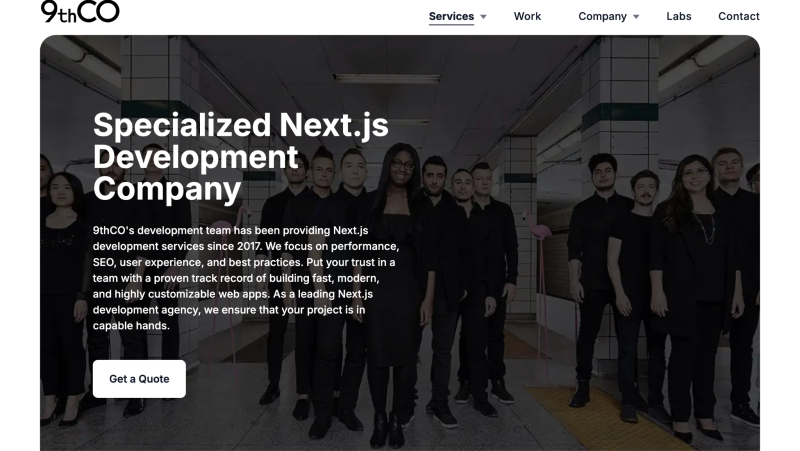
9thCO is a digital agency founded in 2013 with an origin story that sets it apart: born as a technical SEO firm, it has organically grown into a comprehensive full-stack design and development agency. 9thCO’s website rebuild, moving off Drupal 8 to a Next.js and Storyblok stack, saw Core Web Vitals scores improve from 73 to 100, with the team going from staging to live in a matter of days. A separate headless CMS project resulted in a 26.2% increase in FTB sales.
Best fit: Mid-market brands and e-commerce operators that need a headless CMS migration handled without SEO regression—particularly teams on Drupal, WordPress, or legacy platforms looking to move to Storyblok or Strapi on a Next.js frontend, with in-house SEO validation baked into the delivery process.
Tech stack: Next.js, React, TypeScript, Storyblok, Strapi, Sanity, Prismic, Shopify Plus, Auth0, Prisma, Node.js, Vercel
9. Echobind
Hourly rate: not publicly available
Timezone: EST/EDT (UTC−5/−4), US-based (Boston, MA & Encinitas, CA)
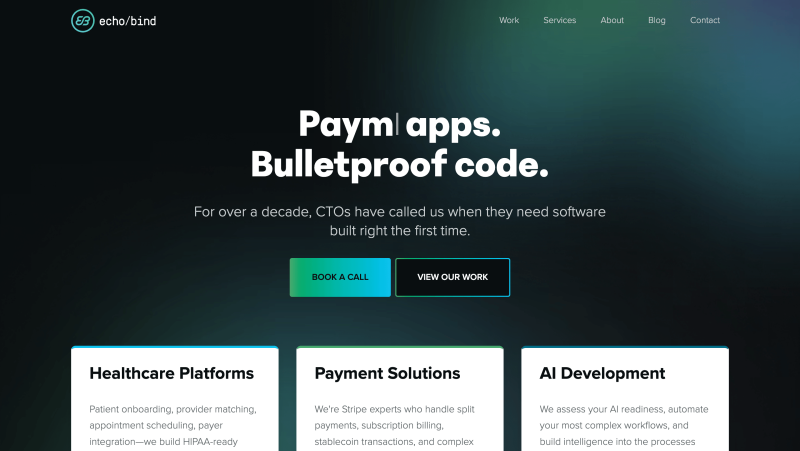
Echobind is an engineering consultancy founded in 2015, operating at the intersection of React Native, React, Node.js, design, and digital strategy. They self-describe as an engineering-first firm specialising in healthcare, payments, and AI solutions delivered by senior engineers. Their practice spans four documented areas: new product development (from research through to shipped software), improving and extending existing products, team augmentation, and strategic advisory across product, design, and engineering.
Best fit: CTOs and product organisations that need a technical partner to ship mission-critical systems correctly the first time; companies in regulated industries like healthcare and fintech that need engineers who understand domain constraints; teams that want to borrow senior-level strategy, design, or engineering capacity without a long-term commitment.
Tech stack: React, React Native, Next.js, Node.js, Postgres, Figma, plus API and microservices, cross-platform mobile development, and Stripe implementation; more recently expanded into AI and machine learning integration
10. Thinkmill
Hourly rate: not publicly available
Timezone: AEST/AEDT (UTC+10/+11), Australia
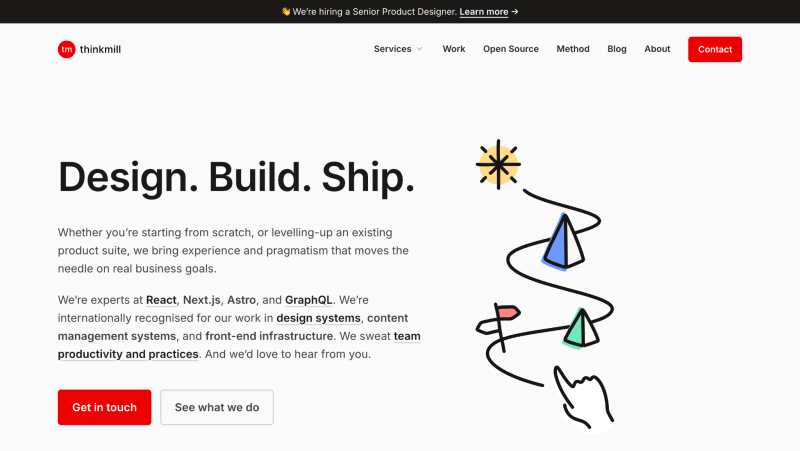
Thinkmill is an engineering consultancy founded in 2013, operating at the intersection of React, Next.js, GraphQL, and headless CMS infrastructure. They are internationally recognised for their work in design systems, content management systems, and front-end infrastructure. Their practice is divided into four documented areas: full product design and engineering (from research through to React front-ends), design systems at scale, CMS migrations and headless architecture, and team augmentation for engineering organisations.
Best fit: Product organisations and engineering teams that need a senior React/Next.js architecture partner with deep design systems expertise; teams migrating from legacy CMS setups to headless; enterprises needing embedded augmentation without creating long-term dependency.
Tech stack: React, Next.js, Astro, GraphQL, Keystone, Keystatic, TypeScript, Node.js, Vercel, JAMstack solutions
11. Brainhub
Hourly rate: $70-120
Time zone: CET/CEST (UTC+1/+2)
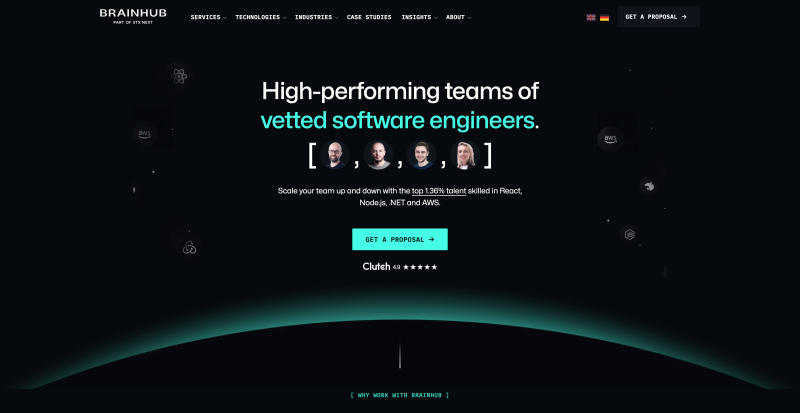
Brainhub is a software engineering agency whose primary engagement model is team extension — embedding senior engineers into client development teams rather than delivering end-to-end project builds. Their React and Next.js capability is oriented toward SaaS frontend development within existing engineering organisations. Clutch rating 4.9/5 (self-reported).
Best fit: Engineering teams that have an existing Next.js codebase and need senior frontend engineers embedded for 6–18 months rather than a full agency build.
Tech stack: React, Node.js, .NET, TypeScript, AWS, React Native
12. Lemonhive

Hourly rate: $80-130
Time zone: GMT/BST (London, UTC+0/+1); global remote teams
Lemonhive is a consultancy focused on complex MACH (Microservices, API-first, Cloud-native, Headless) architecture builds. Their primary clients are digital agencies that need white-label Next.js and headless CMS delivery depth, and brands with complex integration requirements across commerce, CMS, and authentication layers.
Best fit: Agencies seeking a white-label Next.js engineering partner; brands with complex multi-system integrations requiring MACH architecture expertise.
Tech stack: Next.js, Shopify Hydrogen, Sanity, Storyblok, Payload, React Native, SvelteKit
13. 10Clouds

Hourly rate: $55-95
Time zone: CET/CEST (UTC+1/+2)
10Clouds is a software company with a documented specialisation in AI-powered digital products, fintech platforms, and machine learning integrations. Their Next.js capability supports frontend delivery within backend-heavy product builds. They are better suited to projects where the primary engineering challenge is backend complexity or AI integration rather than frontend architecture or CMS-driven content operations. Self-reported clients include Pinterest and Displate.
Best fit: Fintech or AI-product companies that need Next.js frontend work as part of a larger full-stack or AI-engineering engagement.
Tech stack: React, Next.js, Flutter, Python, Django, machine learning tooling, AI/LLM integrations, DevOps
14. Rigby
Hourly rate: $60-100
Time zone: CET/CEST (UTC+1/+2) / Poland
Rigby is an e-commerce development agency focused on custom B2B, B2C, and multi-vendor commerce platforms. Their technical differentiation is depth in Medusa.js, an open-source headless commerce engine, alongside Next.js for the frontend layer. This Nextjs agency is right choice if you need to build a custom marketplace, subscription platform, or multi-tenant commerce system, and a poor fit for CMS-driven marketing sites or SaaS dashboards.
Best fit: Companies building custom B2B or B2C commerce platforms with complex models — marketplaces, subscriptions, multi-vendor, multi-tenant — on a modern headless stack.
Tech stack: Next.js, React, Medusa.js, TypeScript, Node.js, composable commerce tooling
15. Sidebench
Hourly rate: $50-$99/hr (Clutch-listed),
Timezone: PST/PDT (UTC−8/−7)
Sidebench is a UX design from Los Angeles, and software engineering consultancy founded in 2012, with a primary focus on healthcare digital transformation and high-growth ventures. They bring together four strengths in a single team: technology and product strategy, UX-first product design, pragmatic systems and data architecture, and secure, HIPAA-compliant engineering. Their work spans structured discovery and roadmapping, net-new mobile and web platform builds, and enterprise digital transformation.
Best fit: Healthcare innovators, funded startups, and enterprise innovation groups that need structured discovery, compliance-aware (HIPAA) design, and senior product stewardship on complex mobile and web platforms. Not the right fit for cost-sensitive projects or rapid staff augmentation needs.
Tech stack: React, AWS, React Native, iOS, Android, Node.js, AngularJS
Key Things to Know Before Hiring a Next.js Development Agency
- If organic search is your core growth channel, working with a Next.js development agency that integrates technical SEO into the engineering process from day one is the most important selection criterion
- Check the relevant portfolio: case studies that show business outcomes (conversion lift, traffic growth, faster workflows) are more valuable than generic gallery screenshots
- The best choice also depends on your project type: SaaS app, ecommerce, enterprise migration, startup MVP, or a marketing site. Compare and match your needs with the appropriate developers experience
Wrapping Up on Next.js Services
Next.js development services are in high demand among product teams and marketing organizations that need fast, SEO-optimized web experiences without sacrificing developer flexibility. As a React-based framework with built-in support for server-side rendering, static site generation, and edge deployment, Next.js has become the default frontend choice for headless CMS architectures, including Sanity-powered builds.
Companies looking for Next.js services typically want more than framework expertise: they need engineers who are good at Core Web Vitals, App Router architecture, incremental static regeneration, and know how to wire a performant frontend to a structured content backend. Plus, AI tool integration won't be superfluous. Whether you're migrating a WordPress site, launching a composable commerce storefront, or rebuilding a marketing site as a product, the right Next.js development partner brings both the engineering depth and the editorial UX thinking to ship something that ranks, converts, and scales.
FAQs about Next.JS developers market and Nextjs Agencies
1. What is a Next.js development agency?
A Next.js agency is an engineering company that specialises in building, migrating, and scaling web applications using Next.js — the React meta-framework maintained by Vercel. Unlike a general web development agency, a dedicated Next.js agency employs developers who work primarily with Next.js framework, meaning they have hands-on experience with the App Router, React Server Components, Vercel deployments, and headless CMS integrations. When your Next.js project involves performance-critical rendering, multi-language content architecture, or a migration from a legacy platform, a specialist Next.js agency will make different, and usually better architectural decisions than a generalist team that treats Next.js as one tool among many.
2. How much does a Next.js agency charge on average?
We can't guarantee 100% accuracy, because everything depends. However, hourly rates for Next.js agencies' services in Western Europe (UK, Netherlands, Germany) range from $80 to $150. Central European agencies (Poland, Ukraine) typically range from $40 to $100. Total Next.js project costs for a headless CMS migration or a new SaaS marketing site range from $30,000 to $200,000+ depending on content volume, language count, integration complexity, and post-launch support requirements. A Next.js project that involves multiple languages, CMS editorial workflows, and Vercel enterprise deployment will sit toward the upper end of that range regardless of the agency's day rate.
3. What headless CMS platforms work best with Next.js in 2026?
Sanity CMS, Storyblok, Contentful, and Payload CMS are the four platforms with the deepest documented Next.js App Router integrations. Sanity and Storyblok have native visual editing and draft mode support for React Server Components. Payload CMS is a TypeScript-first, self-hostable CMS that can be run within the same Next.js application. The right CMS choice depends on editorial workflow requirements, content model complexity, localisation needs, and whether the team wants a hosted or self-hosted solution.
4. What should a Next.js agency deliver at project close?
A production-quality handover from a Next.js agency includes: a TypeScript codebase with automated tests (unit, integration, and ideally end-to-end); documentation covering content model schema, component architecture, and deployment processes; redirect mapping validated against the pre-launch crawl; a configured Vercel project with environment variables scoped correctly to staging and production; editor training and documentation for the CMS; and a defined post-launch support period with documented SLAs for critical and non-critical issues.
5. Where to find Next.js agencies proven by real reviews?
Many businesses usually use and find Next.js development company on platforms like Upwork, LinkedIn, or Toptal searching for a dedicated Next.js company. Take Clutch reviews as a guarantee, because its verification system excludes fraudulent schemes and fake testimonials, which differs from the dozens of other services and web platforms that list developer agencies.
6. Does a Next.js Agency like FocusReactive offer post-launch CMS support and team training?
Yes, CMS agencies in this niche typically provide ongoing help rather than just a one-off build. FocusReactive offers post‑launch CMS support, though the exact format of the majority of Next.js service are usually tailored only per project.
7. When should I hire a Next.js agency instead of a freelancer?
A Next.js agency makes more sense when the project has moving parts that require multiple disciplines at once (architecture, frontend, CMS configuration, DevOps, QA), when the stakes of getting the architecture wrong are high, or when you need continuity after launch.
This becomes especially important for enterprise website migrations, where URL preservation, redirects, SEO continuity, content migration, and multiple integrations need to be managed together. See our enterprise website migration guide for more detail.
A freelance developer is the right choice when scope is tight, the project is well-defined, and you need one or two specific skills: a performance audit, a CMS integration, a specific component build.






















Comments