
Storyblok CMS agency quality varies less on platform familiarity and more on content-modeling discipline, website migration methodology, and post-launch governance. We've chosen 10 Storyblok services, proven by real expertise. A top Storyblok agency is evaluated by its ability to architect the right Storyblok implementation for your specific content model, editorial workflow, and scalability needs. This guide is not only about the top Storyblok agencies in the market based on proven platform expertise, composable architecture experience, and measurable content with performance outcomes. It helps to assess the service objectively: its core stack, trends in the content management market and content management software, the most well-known companies that work with Storyblok daily, and other non-obvious recommendations.
TL;DR
- Gartner projects that 70% of enterprises will adopt composable DXP architecture over monolithic suites by the end of 2026 — and Storyblok's hybrid model (a single authoring layer paired with headless delivery) is the path enterprises are choosing into that shift, which is exactly why the delivery partner matters as much as the platform choice;
- Custom frontend development, third-party integrations, and legacy-platform migration are the real cost drivers on a Storyblok project, CMS services are reportedly among the fastest-growing segments of the market, expanding at roughly 16% a year;
- The best Storyblok development agencies combine several things: disciplined content-modeling, migration methodology, and multi-platform integration experience;
- If you need a Storyblok development partner in 2026, shortlist FocusReactive, Dotfusion, Anything, take it_, and Webstacks. If you're unsure where to start, FocusReactive is the safe default for CMS migrations and multi-brand builds that need to hold up under SEO scrutiny, backed by the most fully verified evidence record in this guide (4.9/25 on Clutch, an official four-platform partnership, and a named, quantified case study).
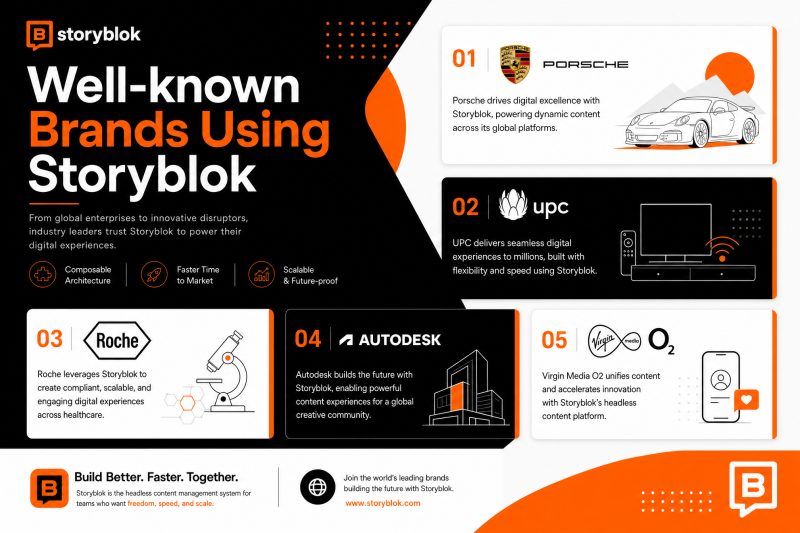
According to official statistics, Storyblok powers more than 200,000 projects worldwide, underscoring the growing shift toward component-driven, API-first content workflows that enable developers and marketers to collaborate and ship digital experiences faster. Here are some well-known businesses that use Storyblok CMS for content management.
How to use this Storyblok guide
Read how we evaluate delivery methodology first if you're building a shortlist from scratch. The agencies at a glance section is the fastest way to compare offices, timezone overlap, stack, typical business cases, and verified evidence side by side.
If you're specifically looking for an agency that can migrate your site to Storyblok, or you just need a smaller development studio/ Storyblok website agency for a single marketing site rather than a full platform rebuild, our at-a-glance tables and the FAQs below are the fastest path to find you Storyblok service.
How we've evaluated the Storyblok CMS Agencies
Why agency choice is the real variable
Storyblok itself is rarely the point of failure. The platform's component model and visual editor are well documented and consistent across implementations. What varies enormously is what an agency does with that flexibility.
The failure modes show up in predictable places. A content model built without an audit of existing content types produces duplicate blocks and inconsistent field naming within a year. A migration without a programmatic redirect matrix loses indexed URLs and takes 6-12 months of organic traffic to recover. A visual editor configured without editorial workflow design hands marketing teams a technically correct CMS that nobody enjoys using. None of these are Storyblok problems — they're methodology problems that show up regardless of which headless CMS is involved.
That's the lens this guide uses: not "does this Storyblok development agency know the platform," but "does this agency have a repeatable methodology for the parts of a Storyblok project that actually break", and can it show you evidence, not just a claim.
Benefits of Storyblok CMS
Content Management
- Nested component architecture. Storyblok's block-based content model lets editors build and reorder page sections without developer involvement. Components are reusable across stories, reducing duplication and keeping content structures consistent at scale.
- Centralized multi-space management. Organizations running multiple brands or regional sites can manage them from a single Storyblok organization account with granular role and permission controls per space.
- Scheduled publishing and workflow states. Content can move through draft, review, and published states with time-based release scheduling, making editorial pipelines predictable and reducing last-minute deployment risks.
- Asset management with DAM. Built-in digital asset manager supports folder organization, metadata tagging, image transformations via URL parameters, and focal point cropping
- Localization and internationalization. Field-level translation with per-locale publishing states, combined with folder-based or space-based multi-language setups, gives content teams fine-grained control over regional content variants.
Usability
- Visual editor with real-time preview. The live preview panel renders changes as editors type, which significantly shortens the feedback loop between content authoring and visual verification — especially valuable for non-technical stakeholders.
- Flexible field types and content types. Rich text, tables, custom blocks, relations, assets, and conditional fields cover the majority of editorial needs without requiring custom plugin development.
- Low learning curve for editors. The UI follows familiar CMS conventions close enough that editors with WordPress or basic CMS experience can become productive within days, not weeks.
- Collaboration features. Real-time comments, task assignments within stories, and audit logs support editorial teams working asynchronously across time zones.
- Mobile-friendly interface. The Storyblok management UI is responsive, allowing content reviews and minor edits from mobile devices without friction.
Maintenance
- API-first, headless architecture. Decoupling content from the front-end means CMS upgrades never break the presentation layer. Teams can update front-end frameworks independently of CMS configuration.
- Webhooks and event-driven integrations. Content events (publish, update, delete) trigger webhooks that connect to build pipelines, CDN invalidation, or third-party services — reducing the need for manual deployment triggers.
- Versioning and content history. Every story revision is stored and restorable, which reduces the risk of accidental content loss and supports compliance requirements.
- Managed infrastructure. As a SaaS headless CMS, Storyblok handles server maintenance, security patches, CDN delivery, and uptime — eliminating the operational overhead of self-hosted CMS platforms like WordPress or Drupal.
- SDK and community ecosystem. Official SDKs for JavaScript, React, Vue, Next.js, and Nuxt, plus an active partner and community ecosystem, keep integration and troubleshooting costs low over time.
The Best Storyblok CMS Agencies at a Glance
Location and delivery model
Agency | Core office | Timezone coverage | Founded / track record |
|---|---|---|---|
| 1. FocusReactive | Amsterdam (Netherlands), London (UK), Warsaw (Poland) | CET and ET business hours | Founded 2019; 10–49 employees (Clutch / RightFirms, SoftwareWorld) |
| 2. Dotfusion | Toronto & Montreal (Canada), Orange County (USA), Marseille (France), Phnom Penh (Cambodia) | Spans ET, PT, CET, and ICT across five offices | 27-year track record; three named partners (Chris Bryce, Janice Lee, Riley Mcmeekin) |
| 3. Anything | Manchester (UK) | GMT/BST | 10+ years in headless CMS overall; 4+ years Storyblok-specific |
| 4. Americaneagle | Des Plaines, IL (HQ), plus Chicago, Cleveland, Ft. Wayne, LA, Milwaukee, Nashville, NY, Washington D.C.; Brighton (UK), Sofia (Bulgaria), Valencia (Spain), Zurich (Switzerland) | Primarily ET, with CET/GMT coverage via EU and UK offices | Large, multi-decade full-service agency; Storyblok is one of ~19 platform practices listed |
| 5. Webstacks | USA (exact HQ city not independently verified in this pass — confirm) | US business hours, exact zone unconfirmed | Not independently verified |
| 6. mindtwo | Germany (exact city not independently verified) | CET | Not independently verified |
| 7. Luminary | Australia | AET | Not independently verified |
| 8. Mediaworks | UK | GMT/BST | Not independently verified |
| 9. Friendventure | Germany | CET | Not independently verified |
| 10. take it_ | Berlin, Germany | CET | Founded by Wessel van der Pal (Storyblok Dev Ambassador) and Andreas Sauer; regularly hosts the Storyblok CMS Meetup Berlin |
Frontend, stack, and partner tier
| Agency | Frontend | Common stack & integrations | Storyblok partner tier |
|---|---|---|---|
| 1. FocusReactive | Next.js | Vercel, proprietary CMS Kit starter, in-house AI plugins | Official / Certified Partner (also official partner for Sanity, Contentful, Payload) |
| 2. Dotfusion | Next.js (primary), Nuxt, Gatsby, Astro | Vercel, Netlify, AWS, Azure, GCP; Shopify, BigCommerce; HubSpot, Marketo, Salesforce; Cloudinary, Bynder; Algolia | Official Partner (also Agility CMS, Contentful, Magnolia) |
| 3. Anything | Astro | Netlify, Algolia, Salesforce, Microsoft Dynamics 365 | Certified Partner; UK & Ireland Solution Partner of the Year, 2025 (Storyblok JoyConf) |
| 4. Americaneagle.com | Multiple frontends across platform practices | Vercel, Netlify partnerships; BigCommerce, Shopify, Shopware, SCAYLE, Cloudinary | Silver Partner |
| 5. Webstacks | Next.js (also supports Gatsby and other frontends) | Not independently verified beyond public positioning | Partner tier not stated in public material reviewed |
| 6. mindtwo | Not independently verified | Commerce/middleware systems, per public positioning | Not independently verified |
| 7. Luminary | Not independently verified | Broader DXP stack | Not independently verified |
| 8. Mediaworks | Not independently verified | Marketing/analytics stack | Not independently verified |
| 9. Friendventure | Not independently verified | Design-system tooling | Not independently verified |
| 10. take it_ | Nuxt.js (primary), also Next.js | TypeScript, Tailwind, Netlify hosting; Shopify for headless commerce layers | Certified Partner; first agency to fully specialize in Storyblok CMS; Storyblok "Partner of the Month" recognition |
Outcomes, reviews, and transparency
| Agency | Outcomes (Named Clients) | Clutch Signal | Transparency & Partnership |
|---|---|---|---|
| 1. FocusReactive | Arrive/EasyPark: 35-domain multilingual rollout, 97 Lighthouse score, 38% organic traffic lift | 4.9/25 reviews; $50–120/hr; $10K–$100K typical project (Clutch, verified) | Client reviews describe the team as "an extension" of the client's own, with direct access and minimal sales layering |
| 2. Dotfusion | Borealis Foods and Ramen Express case studies: marketing-team autonomy, faster time-to-market | 11 reviews with consistent praise for transparency and project management (Clutch, verified); $150–199/hr; $50k-$200k typical project | Publishes its own pricing bands publicly on its site; names all three founding partners and senior engineering leads |
| 3. Anything | Amtico: 100% SEO score, 94% accessibility; This is Soho: +110% engagement time, +290% returning visitors | Not independently verified in this pass | Named co-founders (Jono Brain, Mark Holt) speaking on record about the award and client work |
| 4. Americaneagle.com | No Storyblok-specific outcome data found in the platform page reviewed | 4.7 (10) | Moderate — large full-service agency; positioning at the platform-page level is generic rather than named-team |
| 5. Webstacks | Not independently verified beyond public positioning | 5.0 (3) | Moderate — "website as product" framing is public; engagement specifics are not |
| 6. mindtwo | - | Not yet reviewed on Clutch | Moderate |
| 7. Luminary | - | 4.8 (10) | Moderate |
| 8. Mediaworks | - | Not independently verified | Moderate |
| 9. Friendventure | - | No Clutch profile found | Moderate |
| 10 .take it_ | Miles Mobility, Emarsys, Sennder, Apeel | Not independently verified in this pass — confirm current Clutch listing | Named co-founders on record; one holds an official Storyblok Dev Ambassador title, a direct-line signal to the platform itself |
Storyblok CMS Agency profiles: description + the best businesss cases
1. FocusReactive
FocusReactive is a certified Storyblok partner with seven years of dedicated Storyblok delivery, using Next.js as its primary frontend and Vercel hosting. This Storyblok agency is widely praised for its deep Storyblok expertise, consistently delivering high-performance, single-space multi-brand architectures that streamline content across multiple locales. Clients also value their forward-thinking engineering, which bakes proprietary CMS starters and AI-driven SEO directly into every deployment for maximum visibility and efficiency.
FocusReactive operates globally with headquarters in Europe (London and Amsterdam) and teams working across CET and ET time zones to serve international clients. They specialize in building multi-region and multi-language web platforms for notable enterprise and global brands, e.g., EasyPark, Arrive (Netherlands), Tipico (supporting their US market expansion), Xweather / Vaisala (Finland), Caleffi, KidsEmpire (USA) and more.
The best fit for: teams that need a migration to hold up under SEO scrutiny, or multi-brand/multi-region platforms where one CMS space has to serve several editorial teams without fragmenting.
Things to verify: ask for the redirect-matrix documentation and a pre/post-migration crawl comparison from a project similar in scale to yours.
2. Dotfusion
Dotfusion is a Toronto-founded, now five-office agency with a 27-year history and Certified B Corporation status — the only B Corp in the headless CMS space, by its own account. Storyblok is one of four CMS platforms in its practice (alongside Agility, Contentful, and Magnolia), delivered for enterprise clients including Oxford Properties, Brookfield Properties, Moneris, Cirque du Soleil, Intuit Canada, and T-Mobile. Dotfusion is the most price-transparent agency on this list — it publishes phased pricing publicly ($70K–$195K for a full implementation, migrations from $50K).
The best fit for: enterprise buyers who want a long-tenured, multi-platform partner with real Fortune-1000-adjacent references and published pricing to benchmark against.
Things to verify: ask how many of Dotfusion's total implementations were Storyblok specifically versus its other three platforms — the case studies published are strong but not exclusively Storyblok.
3. Anything
Anything Agency is a Manchester-based certified Storyblok partner, and the first agency to be named Storyblok's UK & Ireland Solution Partner of the Year (2025, awarded at JoyConf Amsterdam). Anything has 4+ years of Storyblok-specific delivery and 10+ years in headless CMS overall, with named clients including Amtico, Kingspan, Swizzels, Quorn, and a 12-year-running relationship with high-traffic parenting site Netmums. Its public positioning leans hardest into migrations from legacy enterprise platforms — WordPress, Sitecore, Umbraco, and Adobe Experience Manager.
The best fit for: UK/EU enterprise teams migrating off a legacy CMS where a platform-specific award and long-tenured client relationships matter as reference points.
Things to verify: ask for a current Clutch or independent review count — we found strong case-study and award evidence but no independently verifiable third-party review data in this pass.
4. Webstacks
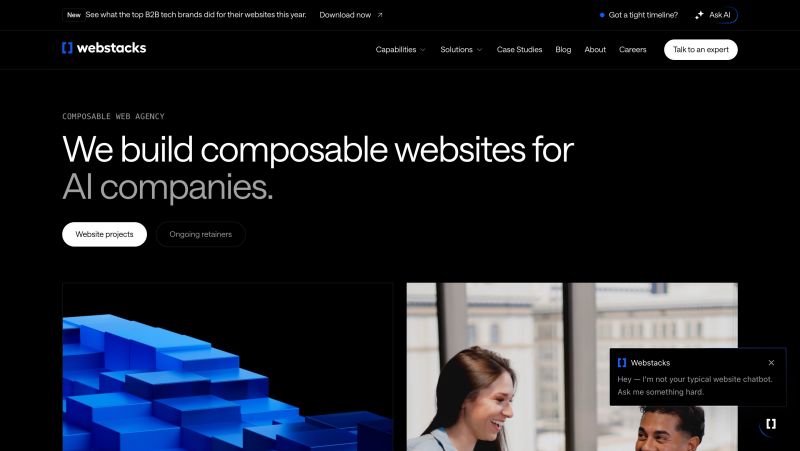
Webstacks is a US-based Storyblok development agency positioned around "website as product" for B2B SaaS, with Storyblok as one of several supported CMS platforms and Next.js/Gatsby as frontend options. Webstacks' public material frames Storyblok work heavily around migration — auditing the existing CMS, restructuring messy content models, and handing off a system the marketing team can scale independently.
The best fit for: VC-backed or growth-stage B2B SaaS companies, particularly US-based teams wanting a partner fluent in SaaS marketing-site conventions.
Things to verify: ask for a reference from a company at a similar stage (seed/Series A vs. later-stage) — the "website as product" positioning is aimed squarely at high-growth SaaS, and fit narrows outside that segment.
5. mindtwo

mindtwo is a German Storyblok agency where the platform is typically deployed as part of a broader composable stack alongside commerce and backend systems, rather than as a standalone content project. mindtwo leans into system integrations and commerce-connected digital platforms.
The best fit for: mid-size and enterprise clients where Storyblok needs to sit inside an existing ERP/commerce/middleware stack.
Things to verify: ask for a specific example of a Storyblok content model integrated with a commerce backend, including how content and product data stay in sync post-launch.
6. Luminary
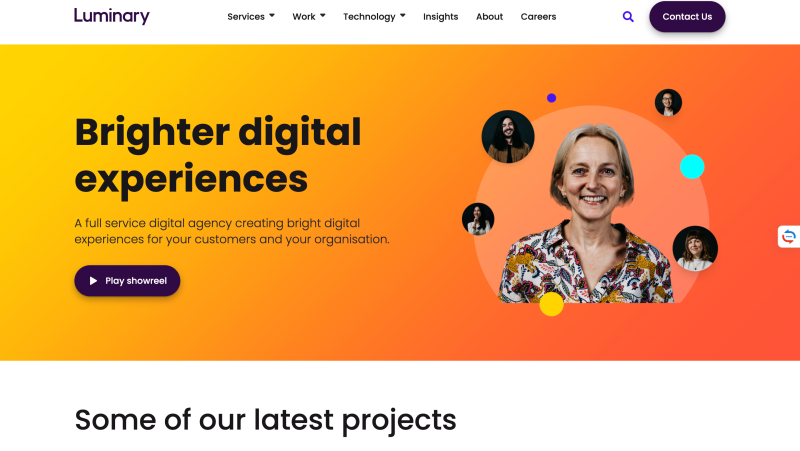
Luminary is a digital agency delivering enterprise-grade digital experience platforms, with Storyblok CMS appearing as one option within larger modernization engagements. Luminary is well suited for large organizations seeking a structured and strategic roadmap with CMS modernization.
The best fit for: large organizations where the Storyblok decision is downstream of a broader digital-strategy engagement, not the entry point.
Things to verify: ask how much of the team assigned to your project has hands-on Storyblok delivery experience specifically, versus general DXP/CMS experience.
7. Mediaworks
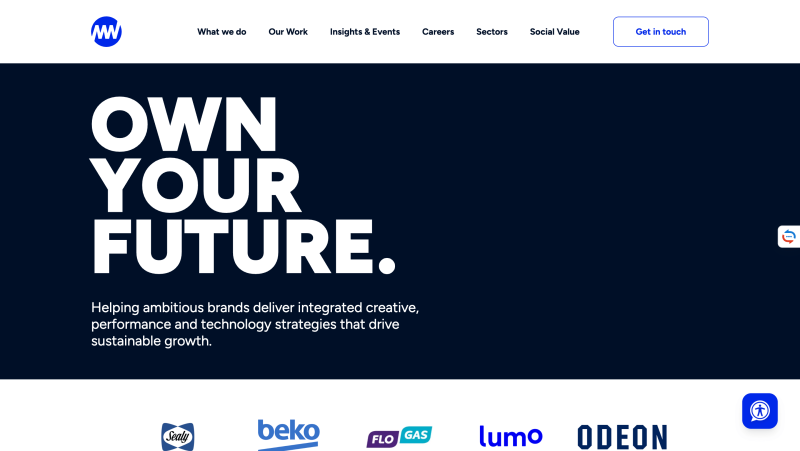
Mediaworks is a digital company from England. The team combines different services: marketing strategy with technical implementation, with headless CMS projects often integrating performance marketing, SEO, and conversion optimization. They position themselves as a single partner for both the build and the marketing performance layer around it.
Best fit for: organizations that want one vendor accountable for both the CMS build and the marketing/conversion outcomes riding on it.
Things to verify: ask for a case study where the technical delivery and the marketing-performance reporting came from the same team, not two disconnected workstreams.
8. Friendventure
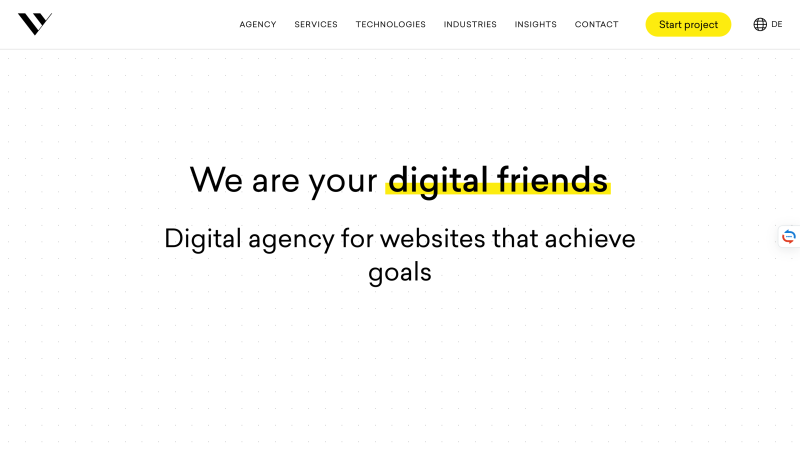
Friendventure is a Germany-based Storyblok website agency combining strategy, design, and technical delivery, with the platform work generally sitting inside broader brand and digital-experience engagements. Friendventure is a strong match for brands that prioritize visual design and user experience alongside CMS flexibility.
Best fit for: brand-forward relaunches where the visual design system is as much the deliverable as the CMS architecture.
Things to verify: Don't skip the post-launch component governance question — component sprawl hits design-led builds hardest when naming conventions aren't nailed down early on.
9. take it_
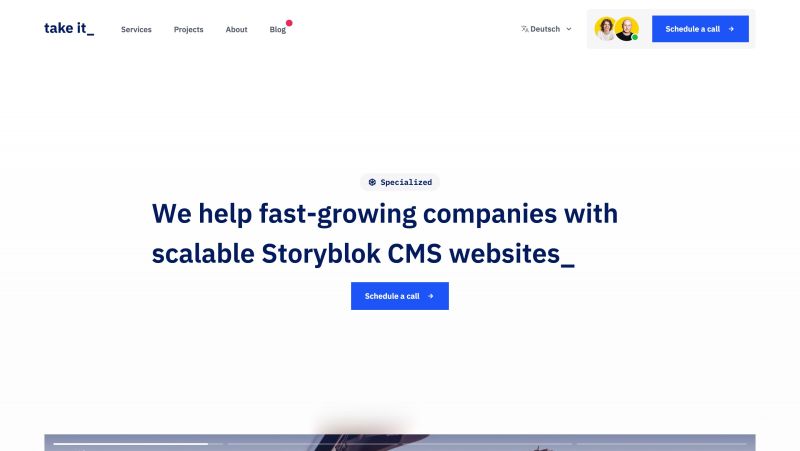
Takeit is a Berlin-based agency development and design agency which fully specializes in Storyblok CMS development. The team doesn't run a multi-platform practice the way most agencies on this list do. take it_ focuses specifically on B2B SaaS and tech companies, with a client roster including Miles Mobility, Emarsys, Sennder, Apeel, and NGRAVE. Co-founder Wessel van der Pal holds an official Storyblok Dev Ambassador title, and the agency regularly hosts the Storyblok CMS Meetup in Berlin — both real signals of a close, ongoing platform relationship rather than a one-off certification. Its primary frontend is Nuxt.js, with Next.js as a secondary option.
Best fit for: B2B SaaS and tech companies, particularly in the DACH region, that want a partner narrowly and specifically focused on Storyblok rather than one platform among several.
Things to verify: ask for a current Clutch or independent review count — we found strong named-client and platform-relationship evidence but no independently verifiable third-party review data in this pass, and no quantified outcome stats comparable to FocusReactive's or Anything's case studies.
10. Americaneagle.com
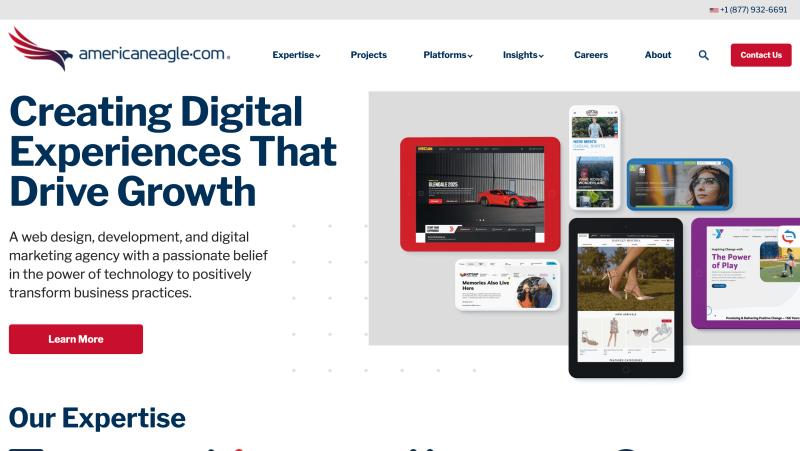
Americaneagle is a large, multi-decade full-service digital agency headquartered in Des Plaines, Illinois, with roughly a dozen offices across the US, UK, Bulgaria, Spain, and Switzerland. Storyblok is a Silver Partner-tier practice — one of around 19 platforms Americaneagle.com supports, alongside Sitecore, Salesforce, Shopify, Drupal, and others. Its Storyblok page emphasizes integration breadth (Vercel, Netlify, BigCommerce, Shopify, Shopware, SCAYLE, Cloudinary) over Storyblok-specific case evidence.
Best fit for: enterprises already standardized on Americaneagle.com for other platforms who want to add a Storyblok workstream under an existing vendor relationship, rather than teams specifically shopping for Storyblok depth.
Things to verify: ask how many Storyblok-specific projects (not total platform-agnostic projects) the assigned team has actually delivered, and request a Storyblok-specific reference — the published material didn't surface one.
Client experience and technical scope
This table covers how it's to work with, and whether the potential Storyblok partner actually understands the non-functional requirements — performance, SEO, security, scalability — that determine whether a Storyblok site holds up after launch, not just at the demo.
Agency | Transparent communication and project management | Post-launch support | SEO, website performance, security | Verification |
|---|---|---|---|---|
1. FocusReactive | Strong | Strong | Strong | Verified (Clutch reviews cite "structured approach with clear timelines" and "consistent and transparent" communication) |
2. Dotfusion | Strong | Strong | Strong | Verified for communication (Clutch); directional for support, inferred from 9–14 year client relationships rather than a stated SLA |
3. Anything | Moderate | Strong | Strong | Directional — support inferred from a 12-year Netmums relationship; performance/SEO backed by the Amtico case study (100% SEO score, 94% accessibility) |
4. Americaneagle.com | Moderate | Strong | Strong | Directional — support and security claims (24/7 monitoring, ISO 27001, 99.99% uptime) are stated on the platform page but not independently verified for the Storyblok practice specifically |
5. Webstacks | Moderate | Moderate | Moderate | Directional |
6. mindtwo | Moderate | Moderate | Moderate | Directional |
7. Luminary | Moderate | Moderate | Moderate | Directional |
8. Mediaworks | Moderate | Moderate | Moderate | Directional |
9. Friendventure | Moderate | Moderate | Moderate | Directional |
10. takeit Agency | Moderate | Moderate | Moderate | Directional |
Two things worth pressure-testing here rather than taking at face value: a "Strong" post-launch score built on client tenure (Dotfusion, Anything) is a good proxy but not the same as a documented support SLA. A "Strong" security/scalability score built on stated certifications (Americaneagle's ISO 27001, 99.99% uptime) describes the platform claim on their page, not a verified audit of their specific Storyblok delivery worth a direct question if compliance is a hard requirement for your project.
What these engagements typically cost?
Storyblok's own platform pricing starts with a free Community tier and paid plans from roughly $90/month; enterprise and multi-brand setups move to custom pricing directly through Storyblok. That's a small fraction of total project cost — agency services are the larger line item, whether you're hiring a full-scope Storyblok agency for a multi-region platform or a smaller Storyblok website agency for a single marketing site.
Two agencies in this guide publish or have verified pricing data, which gives a useful real-world range: FocusReactive's Clutch-reported projects run $10K–$100K, and Dotfusion publishes $70K–$195K for a full implementation (discovery through launch), with migrations starting around $50K. Treat these as reference points, not quotes — project cost depends heavily on content volume, integration count, and redirect complexity.
Across the agencies in this guide, project timelines tend to fall into three bands regardless of which partner you choose:
- Standard implementation (new site, single market, moderate component count): 6–10 weeks, discovery to launch.
- Structured migration (from WordPress, Webflow, Drupal, or an enterprise CMS, with content modeling and SEO continuity work): 10–16 weeks, depending on content volume and redirect complexity.
- Enterprise or multi-region build (multi-language, multi-site, or commerce-integrated): 16–24 weeks, usually phased.
Get a written scope against one of these three bands from every agency you talk to — a quote that doesn't map to a timeline band, or a timeline that doesn't account for redirect/content-audit work, is worth pressing on before you sign.
Seven questions to ask before you sign
- Show me a content audit or content model you produced for a client, not just the finished site.
- Walk me through your redirect and URL-mapping process for a migration of similar content volume to mine.
- How do you validate SEO continuity after launch? Do you run a pre/post crawl comparison?
- Who specifically will be on this project — names, seniority, and how much hands-on Storyblok time they have?
- What does the visual editor setup look like for our actual editorial team, not a generic demo?
- What happens to the component library after the 1st year of launch? Is there a governance plan, or does that fall to us?
- Can you share a rate card or a sample SOW before the first call, and can I talk to a reference client from a project similar in scale and industry to mine?
Quick verdict: the top 3 Storyblok development leaders nowadays
Across the delivery-methodology matrix, the client-experience table, and independently verifiable Clutch data, three agencies separate from the rest of the field: FocusReactive, Dotfusion, and Anything.
1. FocusReactive
FocusReactive is the only Storyblok CMS development company with a fully verified evidence stack across every criterion scored here: a 5.0/23 Clutch record with named project detail, an official partnership spanning four CMS platforms, and a quantified case study (35-domain rollout, 97 Lighthouse score, 38% organic traffic lift). Three things specifically set it apart:
- Faster project start-up. The CMS Kit starter and in-house AI tooling are built to compress the gap between kickoff and a working first sprint — several other agencies in this guide, Dotfusion among them, publish a standalone 2–3 week discovery phase as a separate billed step before any build work begins. FocusReactive's tooling is designed to fold much of that runway into the build itself.
- Automated post-launch support. Where post-launch support for most agencies in this guide is a human-hours retainer, FocusReactive backs live sites with custom AI agents built into the CMS Kit tooling, handling routine content and component monitoring automatically rather than waiting on a support ticket queue.
- Proof over promises. FocusReactive's sales process leans on a working proof-of-concept or MVP early in the relationship rather than a pitch deck — prospective clients see functioning code before they see a proposal.
2. Dotfusion
The only digital agency in this guide with 27-year track record and publicly published pricing. It make the team the most transparent large-agency option here, though Storyblok is one of four platforms in its practice rather than a dedicated focus.
3. Anything
This is the agency that holds a third-party award directly from Storyblok itself (UK & Ireland Solution Partner of the Year, 2025). Strong named case studies (Amtico, This is Soho) and a 12-year client relationship (Netmums) back its post-launch and SEO/performance scores.
How to Choose a Storyblok Agency That Fits Your Marketing Team's Needs
Choosing the right Storyblok agency is not just a technical decision. It requires evaluating your marketing team's goals, contentgovernance requirements, editorial workflows, and long-term growth strategy. The ideal agency should understand how to implement theStoryblok CMS in a way that supports both business objectives and day-to-day content operations.
For most organizations, content managers, digital marketers, and SEO specialists are the primary users of a content management system.This is one of the reasons why Storyblok is widely recognized for its visual editing experience, which enables non-technical teams to create, edit, and publish content without relying heavily on developers. As a result, marketing teams can improve content velocity,streamline collaboration, and accelerate time-to-market.
When evaluating a Storyblok CMS agency, prioritize partners that align their implementation approach with your content strategy, internal capabilities, and scalability requirements. A well-executed Storyblok implementation can lead to faster onboarding, lower operationalcomplexity, improved content governance, and a stronger return on investment over time.
FAQs about Storyblok agencies and Migration costs
How do I find an agency that can migrate my site to Storyblok CMS?
Start with the seven criteria in this guide, ask specifically for a documented redirect matrix, a pre/post-migration crawl comparison, and a content audit process, since those are the parts of a Storyblok migration that most commonly go wrong. For example, FocusReactive, Anything, Dotfusion, and Webstacks lead specifically on migration methodology if that's your primary need.
What does a Storyblok agency actually do?
Storyblok provides the content platform: the visual editor, the API, the component framework. An agency designs the content model, builds the frontend (usually Next.js or a similar React framework), configures editorial workflows and permissions, and handles the migration process (replatforming), all redirects, and SEO continuity work that determines whether the move helps or hurts organic performance.
How long does a Storyblok migration take?
Most fall into 10-14 weeks for a structured migration from a legacy CMS, or 16–24 weeks for multi-region or commerce-integrated builds, depending on content volume and redirect complexity.
How much does a Storyblok agency cost per hour?
Based on Clutch data from verified client reviews, Storyblok development agencies typically charge $50–$99/hr, with rates scaling by agency size and specialization. Budget-focused shops (often offshore) start around $25–49/hr, while established agencies with senior teams charge $100–150/hr, and premium or enterprise-focused partners run $150–199/hr. For comparison, general web development agencies on Clutch average just $25–49/hr — meaning Storyblok specialists command a premium, reflecting the more senior, composable-architecture expertise the platform demands.
How much should I trust Clutch ratings when comparing agencies?
Use Clutch for verified client-review content rather than star rank or badge placement, which can be influenced by paid tiers. A 4.9 with 25 reviews and named project detail (like FocusReactive's) is stronger evidence than a badge alone; an agency with no independently verifiable review count isn't necessarily weaker, but it means you should ask for references directly.
Should I pick a dev agency based on region?
The region matters less than time zone overlap with your headless development team and, for enterprise projects, compliance requirements (GDPR, data residency) that a regional partner may already have processes for. It's a secondary filter, not a primary one.























Comments